Sunday, April 12, 2015

Sunday Summary: Boys & Men in Education #slowchated

After a week of discussing boys and men in education, I have even more questions than I did when I started. The biggest of those questions is how I should respond to the statistics that show boys struggling in schools. It's important to not generalize from the statistics: to continue to be responsive to the students in front of me, not the "average student" presented by the numbers. Still, the statistics concern me. How can we make school better for boys and boys better for school? Here is a selection of tweets from the week to assist you in finding your answer to that question.

I started the week with a cold opening. I hoped this question would elicit some emotion and strong opinion.
The answers ranged from uncertainty over whether this claim was true to collections of links about boys performance in school. Most responses, however, shared observations that may point to the problem.


And my first question also brought back the first reminder that we must be careful with these statistics to avoid stereotyping our students.

When I reflected on the statistics shared in my opening statement and from various tweets on Monday, I realized that I had seen many of the behavior statistics play out in my classroom (more frequent suspensions and discipline infractions related to bullying), than I had academic differences between boys and girls. That led to this question:


All of those tweets began to point at the problem, but the next ones really summed it up for me.


I've seen just as much inappropriate behavior from girls as boys, but boys are more likely to break a big school rule that results in harsh consequences like suspension. For example, bullying seems to happen equally with boys and girls, but boys' bullying is more likely to get physical and our school rules are clear that physical aggression results in suspension. Although the humiliation that can come with name-calling and rumors is just as damaging, if not more so, it is more difficult to determine when those behaviors warrant severe consequences.

After spending two days discussing the problem, it was time to look for solutions.
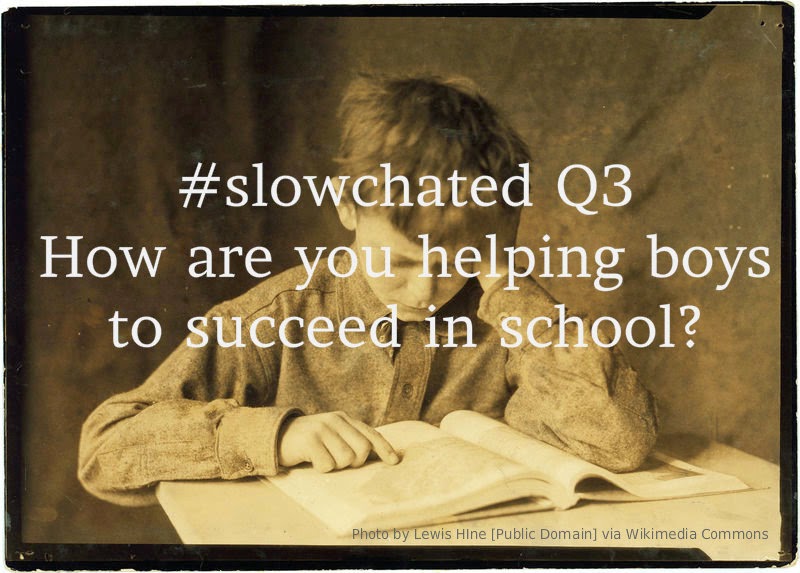
 Interestingly, no one mentioned something specific they were doing for boys. All of these strategies would benefit all students. The key seems to be breaking away from the traditional teacher lectures/student listens model.


Our fourth question went back to the big picture.
 Again, the suggestions were not specific to boys. When schools better meet the needs of all learners, boys' performance and school experience will improve, too.


I ended the week with a question I think about frequently as a male elementary school teacher. I've never worked (or attended) an elementary school with more than three male teachers. I've always felt that some boys get the idea that school and education is a female pursuit when they don't see men teaching classes. Being the Friday question, there weren't too many responses, but I think the one below says it all.
Male role models are important, whether or not they're found in schools. Still, this is an idea I would like to explore more, so I might dedicate an entire chat to this topic in the future.

Thanks to everyone who participated this week. I enjoyed seeing the thought put into the answers for this topic. I look forward to more discussions of big ideas with #slowchated

Tuesday, April 7, 2015

Boys & Men in Education #slowchated April 6 - 11

Boys are 22% more likely to repeat a grade than girls.
For every 100 girls diagnosed with a learning disability, 276 boys are diagnosed.
For over 50 years, girls have outperformed boys on standardized tests measuring reading ability.

"The Dunce" by Harold Copping [Public domain], via Wikimedia Commons
At first I wondered if all of these statistics were telling the truth. As a fifth grade teacher, I never noticed a gender gap in my classroom. I've had high performing boys and girls. I've also had just as many girls as boys requiring additional academic support through remediation and special education programs. Then I thought about it some more. In 12 years of teaching, I can only think of two girls who had an out of school suspension, but every year at least two boys from my classroom were suspended at some point during the school year. Nearly every time a student surprised me with uncharacteristically poor performance on a standardized test it was a boy. The students I've hounded most about homework, my least motivated readers, my students who required in-class aides: all boys. Something is going on here. And it isn't just a problem in the United States. Finland, who is often held up as a model of a successful school system, has twice the gender gap of the United States on the reading portion of the National Assessment for Education Progress.

Photo by deradrian via Flickr
What is causing these problems? Is it the way our schools are run? A Time Magazine article suggested that teachers discriminate against boys. Do we? Or is it boys themselves? Does the development of the male brain differ so much from the female brain to account for these statistics? How can we, as educators, address these issues?

All of these thoughts about boys in school led me to think about the men in my school. I've taught at two different elementary schools and had the distinction of being the only male classroom teacher in the building. Now that I'm the advanced learning specialist, there aren't any male classroom teachers in my building. How does the lack of male teachers in elementary schools affect boys? Current statistics show that men make up only 19% of the entire elementary and middle school teaching force. Could that be part of the problem of boys' underachievement? How can we encourage more men into our profession?

This isn't exactly an opening statement for the chat since we've already been discussing this topic for two days. Every Tweet and every link is giving me more to think about. I jotted down potential questions for the week when I signed up to moderate, but all of the great information we're discussing leads me down different paths. So I won't be posting questions in advance.

Please keep sharing, and remember that the beauty of a slow chat like this is having the freedom to take time. Explore the posted links, find additional statistics and articles to share, and engage with the rest of the #slowchated community. I look forward to seeing what you contribute.

Monday (4/6/2015)
 Tuesday (4/7/2015)
 Wednesday (4/8/2015)
Thursday (4/9/2015)
Friday (4/10/2015)


Saturday, April 4, 2015

Inspiration from #NCCE2015

Image from blog.ncce.org
I've been home from the NCCE-Northwest Council for Computer Education conference for two weeks, and my head is still spinning with all of the educational awesomeness I encountered there. It was my first time at a big education conference, and I did my best to take it all in. I attended 14 sessions and workshops and kept up with countless more via Twitter. I walked every aisle of the exhibit hall, and spent all of my free time connecting with inspiring educators from around the country.

New Tech Ideas
Collaboration is the big idea in education right now. I learned strategies for managing collaborative work in Google Drive including having students experiment with collaborative documents by starting with a spreadsheet with their own assigned rows (thanks Nikki Robertson). Cheryl Steighner hosted a terrific session about Google in elementary schools. One of her ideas is to have a collaborative story that students can add to over time. She has one story that students have continued even two years after leaving her classroom! Throughout my time in Portland, I heard about countless apps, websites, and tools that I will be exploring for months to come.

Connections
As great as the official sessions and workshops were, the best part of attending NCCE was connecting with other educators. There were quite a few sessions about how important it is to build a personal learning network (PLN) through Twitter or another social learning platform. I am a full-fledged Twitter evangelist, and my time at NCCE proved why. Everywhere I went, I ran into people I already knew. We were able to jump in and discuss because we already knew each other's backgrounds. I added many more educators to my PLN so I could continue to learn from them after NCCE.

Excuse the random
photo, but the mens'
rooms in the Portland
Convention Center have
amazing artwork!
One highlight of connecting at NCCE was Wednesday's #IDedchat. We met at a swanky, 30th story bar in downtown Portland to discuss professional development. It was a little strange staring at our phones to chat online when we were in such a beautiful place with great company, but being together created a more festive atmosphere for the chat. Plus, most of us arrived early to share dinner and chat.

I also got to have a wonderful lunch with Cheryl Steighner to discuss tubas and elementary education, and I spent a night on the town with some of my colleagues from Coeur d'Alene (Kelli Ogle and Kiersten Kerr are the only ones on Twitter) and Nikki Robertson from Alabama. I also got to chat with one of the most inspiring bloggers I know, Steve Wyborney, in the exhibit hall. Those informal learning moments were the best of the conference!

Now it's time to put what I've learned in to action. On Monday, I'm hosting a Monday Morning Appy Hour at my school to share some of the iPad apps I learned, and I'm working many of the other ideas I learned into upcoming lessons. It also sparked a desire to attend (and possibly present at) other big conferences. We'll just have to see where that leads, and I'll keep you updated as I continue to experiment and refine...

Sunday, March 15, 2015

Sunday Summary: Authentic Audience on #slowchated

You can relive the entire week's chat with the Storify archive!

From hanging work in the hallway to having my students publish their own book blog, giving kids an authentic audience has been a powerful force in my classroom this year. I was happy to jump in and moderate #slowchated this week to find some other perspectives on authentic audiences.

I started the week with this question:

I was surprised by the wide range of answers. This one matched my initial thoughts on the topic:
 But these ones made me realize that there might be more to choosing a truly authentic audience:

I've been successful at giving my students an audience they have no connection with. I often share our book blog on Twitter tagged with #comments4kids As a result, my kids have received feedback from teachers I know in other parts of the country along with others who have absolutely no connection to me or our school. When we've discussed it as a class, everyone agrees that they take more care with their writing when they are truly publishing it for the world. We don't know who will read it.

I really like the idea of using people with expertise as an authentic audience. When I invited judges for my school's Invent Idaho competition, I asked a friend who is an accomplished tinkerer to view the projects. With his experience in electronics projects and scale modeling, he was able to give students feedback on their projects that I wouldn't have considered. Our district technology coach also judged. He has judged at many of these competitions, so he was able to offer yet another perspective. Going forward, I want to find more opportunities for my students to present to "logical consumers."


There are so many appropriate audiences for students, the key is getting their work in front of someone. The background photo above is a poster some of my math students made after learning about scale drawings. It's been hanging in the hall facing our playground for months, giving my students an authentic audience for their work each time students go in and out the playground doors.

I hadn't directly thought about the benefits of audience awareness before. But, I have seen my students go from assuming everyone knew all about the characters in Harry Potter and other popular series to understanding that they needed to provide that information in their book reviews. I think building audience awareness leads to developing greater empathy. It's definitely an idea worth exploring further.

A few of our slow chatters shared some great things they've done with their students. These were two of my favorites. Please follow the links to see some great student work!


Although most of our discussion was about reaching out, this was a great reminder that our classrooms have a built-in audience. When work is shared with classmates rather than created for teacher eyes only, our students get many of the benefits of having an authentic audience. Doing it successfully, though, often requires teaching what it means to be a good audience, as described in the tweets below.


I've been able to incorporate an authentic audience in my English/Language Arts classes with our book blog, but I really want to give my math students more opportunities to put their work in front of others. Here were a couple other places suggested for authentic audiences.


During Day 4, Mark Crotty suggested that it was worth examining how the structure of school affects authentic audiences. I decided to use his question for our 5th day of discussion:


I love this idea - a school so engaging that the community wants to be a part of it. By opening our doors and sharing the great work of our students, it can become a reality.

Thanks so much to everyone who participated in this week's #slowchated discussion of authentic audience. I'm excited to use what I've learned from this week's chat in my classroom. And I'll keep you updated as I continue to experiment and refine...


Monday, March 9, 2015

Authentic audiences #slowchated March 9 - 15, 2015

Image from Wikimedia Commons
I took great pride in my work for elective classes in high school: often more than I did for my academically required courses. I played tuba in multiple bands, acted in most of our school plays, competed in speech and debate, and wrote for the school newspaper. Now, of course, the fact that I chose my electives was a motivator, but the biggest difference between those classes and my others was the audience. I knew that my work would be on display for my peers and the larger community, not just the teacher. I practiced and practiced the tuba solo in the Holst Suite because I knew how many people would be listening. I carefully revised and edited every submission I wrote for the Timberwolf Times because all of my friends and teachers would read my work. I did fine on the papers that I wrote for my teachers' eyes only, but I rarely put the same type of effort into those assignments.

Coursework in the arts and many electives has always given students an authentic audience, while work in other classes is done solely for the instructor. Why? Personally, it wasn't something I thought about much until recently. In the past, I had my students imagine an audience for their writing, but we rarely wrote for a real audience. This year, I'm starting to give my students real audiences for presenting their work. I've seen how sharing their work with a broader audience motivates and inspires many of my students. Still, I know I can do more and I want to hear your ideas.

These are the questions I have in mind, but they are subject to change as you contribute ideas throughout the week.   

Q1 What makes an audience "authentic"?
Q2 How do your students create for authentic audiences?
Q3 How much audience participation do you want? How do you encourage or discourage it?
Q4 What is something you already do that could be enhanced with an authentic audience?
Q5 Where do you find an audience?
Q6 What is your "dream audience" for student work?

I'm eager to discuss this with you on #slowchated and I hope that you will take full advantage of the slow chat format. We have a whole week to find and post links, photos, and blog posts. Best of all, we have an authentic audience in each other, and audience participation is required. Ask questions, challenge assumptions, and learn from one another!

Saturday, February 21, 2015

Book blog update

The Bryan Book Blog
Before Christmas break, I was at a crossroads with my students' book reviews. I had some very high quality reviews, and others that still needed some work.

Thanks to advice from Erik of This Kid Reviews Books, Pernille Ripp, and some great educators from the Maryland elementary school chat (#mdeschat) I think I've found the way forward. When we returned from break, I told my students to publish when they personally felt ready. It was interesting to see the self-reflection my students used in deciding whether or not to publish.

Students were excited to see their reviews online and read reviews from my other classes. Plus, having the work published has allowed students to collect comments on their work. On one of the first days when students were able to comment on others' work I immediately had two girls come to me for advice. They noticed one of the reviews was full of capitalization and grammar errors. They wanted to know if it was appropriate to comment about it. We talked about making the comments constructive and helpful. They were able to comment in a way that highlighted the strengths of the review while still expressing concern that the review didn't match the quality of our other published reviews.

This review of The Candymakers is one of
the highest quality examples on our blog
Due to privacy concerns, my students had to set up their blog pages with self-chosen pen names. At first I was a little worried about the online behavior that comes with anonymity. In practice, it has been terrific. When students don't know for sure who the author is, I find that they are looking at the content of the book reviews carefully, rather than just heaping praise on their friends' reviews. I've also noticed students trying new books that may have been outside their comfort zones based on a published review.

One of the most exciting things for my students has been receiving comments from outside. I've shared the book blog address with the #comments4kids tag on Twitter a few times. We've received a variety of comments ranging from praise for a job well done to questions that ask the reviewer to dig deeper. I'd love to collect even more comments, so please visit the Bryan Book Blog and add your own.

Unfortunately, I still have a few students who haven't published a book review yet. Most of these are students who recognize that they need to make improvements before publishing, but they are choosing to work on other projects when we have reading/writing workshop. I will communicate my expectation that every student publish one review to the blog before spring break. I'll be checking in with these students to see how I can support them in revision and editing before that deadline rolls around.

Having my students blog has been terrific! I love seeing how the process is evolving this school year as my students publish and receive feedback. I'm also thinking ahead to some changes in my approach for next school year when I'll be able to get started with blogging from the beginning. And I will keep you updated as I continue to experiment and refine...


Monday, February 16, 2015

Happy Presidents' Day!


A few years ago, I decided that I needed to bring fun back into my classroom. All of the pressure to perform on the test, direct instruction initiatives, and fidelity to adopted curriculum was pushing the joy out of my classroom. I happened to grow a winter beard that year and it needed some trimming by mid-February. Since Presidents' Day was just around the corner, I decided to ditch the moustache in favor of Abraham Lincoln's famous chinstrap. Next thing I knew, I was wearing my top hat and posing for pictures to share with my students. They had a laugh at my expense and it sparked some conversations about U.S. History. A fun tradition for my classroom was born.

Each year since, I've been growing "facial hair of the presidents" to celebrate the big day in February. Chester A. Arthur's friendly sideburns followed Lincoln. Then, last year, a friend sent me an inspiring article about a high school student who took photos as all of the presidents. I knew I had to go for it, but I would keep my pace of one per year. A little calculation made me realize I would be in my seventies by the time I finished. I want to complete this project before retirement, so Rutherford B. Hayes and William Howard Taft ushered in an era of double duty for me.

This year's portraits of James A. Garfield and Theodore Roosevelt probably mark the end of bearded and mustachioed presidents for awhile. We'll all have to wait for next year to see how I do at clean-shaven presidential impersonation.
The series continues:
2016 Ulysses S. Grant
2017 Grover Cleveland
2018 Richard Nixon
2019 George H.W. Bush
2020 Calvin Coolidge