Wednesday, February 18, 2026

Presidents Day 2026


Quote from his "Elements of Success," speech given
 at Spencerian Business College, Washington, D.C. 1869

The 20th President of the United States, James Abram Garfield, was in office for only six months: March to September of 1881. He was nominated as a compromise candidate at the 1880 Republican convention. During his short time in office, he worked to reform civil service appointments, advance civil rights for African Americans, and establish a "universal" education system. He was shot by an assassin at the Baltimore and Potomac Railroad Station on July 2, 1881. He died on September 19 as the result of multiple infections stemming from his gunshot wound.

Photo of President Garfield from
Library of Congress

The chief duty of government is to keep the peace and stand out of the sunshine of the people. Letter to H. N. Eldridge 1869

I previously recreated a photo of Garfield in 2015, making a joke about his shared name with a famous cartoon cat. However, after watching the Garfield biopic, Death By Lightning, and learning more about his life, I decided he deserved a second chance, especially now that I am writing more than a cheeky caption for the photos. He rose from humble beginnings through education and hard work. He was a polymath who studied languages, elocution, mathematics, law, and the Bible throughout his life. He worked as a laborer, teacher, preacher, and lawyer before being elected to the Ohio State Senate. After serving in the Union Army, he was elected to the U.S. House of Representatives from Ohio nine times. Throughout these years, he was known as a powerful speaker and writer. I found so many excellent quotes of his that there wasn't room for all of them in this blog post.

My 2015 President Garfield portrait

Next in importance to freedom and justice is popular education, without which neither freedom nor justice can be permanently maintained. Letter accepting the Republican nomination for President

When watching Death by Lightning, I was struck by how much contact the President, his cabinet, and members of Congress had with their constituents. Much of Garfield's workday was spent meeting with the public on the first floor of the White House. In fact, Garfield's assassin, Charles Guiteau, met with him at the White House to request an appointment to the U.S. Consulate in Paris (even though he spoke no French). The President felt he had no reason to fear for his safety. President Lincoln's assassination was seen as a product of the Civil War, not a thing that would happen again. Garfield is quoted as saying, "assassination can be no more guarded against than death by lightning; it is best not to worry about either."

All free governments are managed by the combined wisdom and folly of the people. Letter to B. A. Hinsdale, 1880

When visiting Washington, D.C. this last summer, it appears there is very little contact between our leaders and the public these days. I have called and written to my Congressmen many times over the years and the response is nothing more than a form letter. I have spoken with staffers in their local offices, but I've never felt like my voice was heard by my elected officials at the Capitol. Even though the politicians in Garfield's time had more contact with the public, the voice of the average citizen may not have meant much then, either. It was an era of party bosses and a spoils system for political appointments. Jobs were given to donors and those who otherwise helped get the winning candidates elected. A large portion of the people who met with the president were office-seekers hoping to be appointed. Many of the appointments Garfield made were engineered to keep peace between the rival factions within the Republican Party at the time.

If any theories or opinions of mine can be damaged by facts, so much the worse for my theories. Remarks made in the House of Representatives 1869

With such a short presidency, he didn't accomplish much in office. He was concerned about the overwhelming poverty and illiteracy faced by black people in the South and felt that they were losing their newly won rights through Southern white resistance. Garfield believed that education was the solution and proposed a National Department of Education. It didn't happen during his presidency. In fact, it was 99 years later when the U.S. Department of Education was created. He did appoint Frederick Douglass and a few other African Americans to influential positions in the government. He also reigned in corruption in the post office by demanding the resignation of an assistant postmaster general who was accused of accepting bribes. 

The lesson of History is rarely learned by the actors themselves. Letter to Professor Demmon 1871

I highly recommend watching Death by Lightning to learn a little more about this nearly-forgotten president. It follows both Garfield and his assassin, Charles Guiteau, and it plays almost like a Shakespearean tragedy. The inclusion of Nick Offerman as Vice President Chester A. Arthur provides some comic relief and some of the most memorable moments in the miniseries. That performance will probably result in an additional President Arthur photo from me in the future. You can see a trailer for Death By Lightning below.


The President is the last person in the world to know what the people really want and think.

In addition to politics, Garfield is also credited with creating an original proof of the Pythagorean Theorem using a trapezoid partitioned into three right triangles, with two of them congruent. He is the only U.S. President to publish a mathematical proof.

Garfield's proof as published in the New-England
Journal of Education
, April 1, 1876

For proof that I have been doing this for a long time now, take a look at my past portraits

Monday, February 17, 2025

Presidents Day 2025


Serving from 1977-1981, Jimmy Carter was our nation's 39th president. When he passed away earlier this year, I was reminded of his extraordinary life. His humanitarian work with the Carter Center and Habitat for Humanity almost overshadowed his presidency. Maybe that was by design, after all, he opened his farewell address with the words: 

"In a few days I will lay down my official duties in this office, to take up once more the only title in our democracy superior to that of President, the title of citizen."

He was right, as citizens we are the ones who are truly in charge. The President, Congress, and all of the various state and local elected officials work for us. It is up to us as citizens to hold them accountable to our nation's ideals that have been illustrated in the Declaration of Independence and the Constitution of the United States and expanded through the the last 237 years of legislation, policy, and shared experiences.

Jimmy Carter's Official Portrait
by Robert Templeton

The quote I chose for this year's picture, "We must adjust to changing times and still hold to unchanging principles", came from Carter's Inaugural Address, but he attributed it to his high school English teacher, Miss Julia Coleman. (Please follow the link to read about this remarkable educator).  It is the unchanging principles of our country such as "all men are created equal" from the Declaration of Independence and the reasons given for "We the People" to establish the Constitution: "to form a more perfect Union, establish Justice, insure domestic Tranquility, provide for the common defense, promote the general Welfare, and secure the Blessings of Liberty to ourselves and our Posterity" that have allowed our country to adjust to changing times and expand the blessings of liberty to those who were denied them in our country's past.

It feels like our unchanging principles are currently under attack as our current president is fixing blame and sowing division. The separation of powers and systems of checks and balances established in the Constitution are being ignored as the unofficial Department of Government Efficiency hobbles and remakes our government institutions.

"For American democracy to endure, we must demand that our leaders and candidates uphold the ideals of freedom and adhere to high standards of conduct." 

That quote comes from one of Jimmy Carter's last published writings, a New York Times opinion titled "I Fear for Our Democracy." In it, he lists five things that we must do to preserve our country including resisting polarization and stopping the flow of disinformation. Just as some of his most important work was done as a citizen, these essential tasks need to be the work of us, the citizens of the United States.


A few notes about this year's portrait: We tried to recreate an image from Jimmy Carter's February 2, 1977 address to the nation. I had just the right outfit in my closet (having found the sweater just a few days after Carter's passing). I wasn't able to find a location that would be a suitable stand-in for the White House library, so Sarah digitally inserted the background and aged my photo to match. As always, this photo series is the work of my human family - no artificial intelligence is involved.

You can see the changing times through my past portraits


Monday, February 19, 2024

Presidents Day 2024


Benjamin Harrison, our nation's 23rd president, (and grandson of the ninth president) served from 1889-1893. He admitted Idaho and five other states into the union, created the national forests, and oversaw a great deal of economic legislation, including the first billion dollar budget for the United States. He was called Little Ben because of his 5' 6" height and being the grandson of a former president. He is also known as the Centennial President for being inaugurated 100 years after George Washington. 

Photo by C.M. Bell
held by the Library of Congress
I was not filled with my usual anticipation and joy in the days leading up to this year's presidential portrait. The news of the presidential election coming up this November has already given me my fill of presidential politics. In 1892, Benjamin Harrison faced the same opponent he had beaten four years earlier, Grover Cleveland. However, that seems to be where the comparison ends. Harrison had been known as a front-porch campaigner in 1889, giving speeches from his home in Indiana rather than travelling the country and making headlines. In 1892, his wife was ill and both candidates agreed not to personally campaign and keep things low key and quiet leading up to the election. It's nearly impossible to imagine such a thing with today's barrage of news and sound bites. I, for one, would welcome giving it a try this year!

“I have traversed this broad land of ours, and out of all this journeying, out of all this mingling with our people, I have come to be a prouder and, I hope, a better American.”

For having only four years in office, Benjamin Harrison accomplished many things that we can still see today. He modernized the U.S. Navy, annexed Hawaii, and signed the Sherman Antitrust Act into law. He was also the first president to have his voice recorded and to have electric light in the White House (although he often slept with the lights on because he was afraid of being electrocuted by touching the switches). For being a lesser-known president, he made some incredibly quotable statements. I included one on the photo, but had to add a few more between my paragraphs.

“I pity the man who wants a coat so cheap that the man or woman who produces the cloth will starve in the process.”

Admitting Idaho to the Union has made Harrison a background fixture of my entire life. Growing up on Lake Coeur d'Alene, I always enjoyed a trip across the lake to visit the town of Harrison. As a teacher, most of my career has been spent at Bryan Elementary on Harrison Street. Interestingly enough, if Harrison had won a second term it is likely my school's namesake, William Jennings Bryan, would have been the president to follow him in 1897.

"Great lives do not go out, they go on."

If you care to see my interpretations of some of our great (and not so great) presidents of the past

Monday, February 20, 2023

Presidents Day 2023


John Fitzgerald Kennedy was our nation's 35th president, serving from 1961 until his assassination in 1963. His presidency is remembered for conflict with the Soviet Union and Cuba, progress in spaceflight, and the beginnings of civil rights legislation. He is also remembered as a charismatic speaker.

Photo by Rapoport/Getty

Kennedy has been on my mind since attending a recent teaching workshop on Document Based Inquiry. In one of the sessions, we read speeches by Kennedy and Soviet President Nikita Khrushchev following the Cuban Missile Crisis and endeavored to view those words as ourselves, an American citizen in 1962, and a Russian citizen of that time. It was a good reminder that history is both complex and cyclical. Some of the things said by Kennedy and Khrushchev are not too far from what we are hearing from Biden and Putin regarding Ukraine.

I knew that this year's picture would honor Kennedy when I ran across this quote from his response to a Saturday Review presidential candidate questionnaire in the final days of his 1960 campaign for the presidency.

If this nation is to be wise as well as strong, if we are to achieve our destiny, then we need more new ideas for more wise men reading more good books in more public libraries. These libraries should be open to all—except the censor. We must know all the facts and hear all the alternatives and listen to all the criticisms. Let us welcome controversial books and controversial authors. For the Bill of Rights is the guardian of our security as well as our liberty.

Kennedy was a voracious reader
Photo from JFK Library collection

When I was younger, I aspired to be the President of the United States. In fact, the long term goals in my high school day planner included a run for the presidency in 2028. With less than a decade to go, I haven't yet created relationships in a political party or run for any public office. I hereby declare I will NOT be running for president in 2028.

However, I was appointed to the Coeur d'Alene Public Library Board of Trustees in 2020 and was just elected as chair of that board. Although that position does not require me to bear anywhere near the responsibility required of the President of the United States, the decisions I am making there often require careful deliberation and can weigh heavily on my mind. Much of our work is updating library policy. Making sure that our accessibility policy included miniature horses as service animals and  that other policies are updated to reflect current technology are easy decisions. Other work, such as selecting a new library director, approving COVID safety policies, and figuring out what should be included in a trustee code of ethics have been more difficult.

For the last year and a half on the board, most of our meetings have included public comment concerned about the books that are in the library. As trustees, we have the responsibility to approve a book selection policy, but the actual collection is chosen and maintained by the library staff. The board is also the last stop for any book that is formally challenged by a community member. 

It is my belief that the library should, as Kennedy said, include controversial books and controversial authors. It is up to an individual to choose which of those books come into their home to be read. There may be a question as to where they should be shelved in the library, but there is room in the library (and its book purchasing budget) for books that reflect and books that challenge the values and experiences of everyone in our community. "...We need more new ideas for more wise [people] reading more good books in more public libraries."

Happy Presidents Day! 

Should you seek to fix the blame for my past portraits:

Monday, February 21, 2022

Presidents' Day 2022


Zachary Taylor, our nation's twelfth president, only held that position for less than a year and a half. As such, his presidency ended up being of little consequence.

Source: Library of Congress via National Park Service
(public domain)

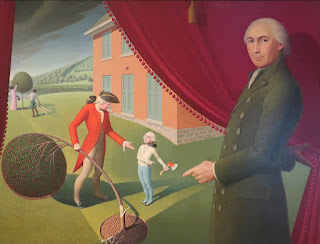
Cherries have often been a symbol of Presidents' Day due to the story of George Washington and the Cherry Tree that first appeared in Parson Weems' A History of the Life and Death, Virtues and Exploits of General George Washington. The book, filled largely with falsehoods, was one of the most influential books of United States history through the first half of the 19th century. In fact, Historian Charles M. McPherson has said that it is likely the only U.S. History Abraham Lincoln studied as a young man. The fabricated cherry tree story was shared with generations of students through its later publication in the McGuffey Reader. It goes as follows:

The following anecdote is a case in point. It is too valuable to be lost, and too true to be doubted; for it was communicated to me by the same excellent lady to whom I am indebted for the last. "When George," said she, "was about six years old, he was made the wealthy master of a hatchet! Of which, like most little boys, he was immoderately fond, and was constantly going about chopping everything that came in his way. One day, in the garden, where he often amused himself hacking his mother's pea-sticks, he unluckily tried the edge of his hatchet on the body of a beautiful young English cherry-tree, which he barked so terribly, that I don't believe the tree ever got the better of it. The next morning the old gentleman, finding out what had befallen his tree, which, by the by, was a great favourite, came into the house; and with much warmth asked for the mischievous author, declaring at the same time, that he would not have taken five guineas for his tree. Nobody could tell him anything about it. Presently George and his hatchet made their appearance. "George," said his father, "do you know who killed that beautiful little cherry tree yonder in the garden?" This was a tough question; and George staggered under it for a moment; but quickly recovered himself: and looking at his father, with the sweet face of youth brightened with the inexpressible charm of all-conquering truth, he bravely cried out, "I can't tell a lie, Pa; you know I can't tell a lie. I did cut it with my hatchet." "Run to my arms, you dearest boy," cried his father in transports, "run to my arms; glad am I, George, that you killed my tree; for you have paid me for it a thousand fold. Such an act of heroism in my son is more worth than a thousand trees, though blossomed with silver, and their fruits of purest gold."

Parson Weems' Fable by Grant Wood, 1939
(Public Domain)

Although it is a charming story, there is no evidence to support it. Yet it was taught for years in school. I even think I read a version in contemporary language when I was in elementary school. That sort of myth-making definitely makes for a feel-good lesson, but real history is so much more interesting. As a teacher, I strive to give my students the truth as we can best understand it after the passage of time. It is important to draw the line between history and historical fiction if we are to prepare students to think critically and make up their own minds about our societal past, present, and future.

Why do I spend half of a blog post about Zachary Taylor talking about Parson Weems' made up story about George Washington's honesty? It is only prelude to the superior Presidents' Day story of cherries, the Washington Monument, and Zachary Taylor (no hatchets required.)

On July 4, 1850, President Zachary Taylor, sometimes referred to as "Old Rough and Ready" for his exploits in the Mexican-American War and his long career in the U.S. Army spoke at the site where the Washington Monument would soon be constructed. To beat the scorching heat of the day, he ate a large amount of raw cherries along with iced milk. Upon returning to the White House, he drank multiple glasses of water. Either bacteria present in one of the foods or the combination of acidic cherries with the milk caused severe stomach pains. Five days later, he died. His last words are reported as “I am about to die. I expect the summons very soon. I have tried to discharge all my duties faithfully. I regret nothing, but I am sorry that I am about to leave my friends.” Although he didn't say it, I bet he regretted his Fourth of July dining choices as well.

Taylor had opposed expanding slavery into the territories added to the United States following the Mexican-American War. For many years after his death, rumors grew that Southern proponents of slavery had poisoned the president. Nearly 150 years later in 1991, Zachary Taylor's body was exhumed to investigate the cause of death. Although trace amounts of arsenic were found, Tenessee coroner George Nicols concluded Taylor's death was caused by any of “a myriad of natural diseases which could have produced the symptoms of gastroenteritis.”

Although this story does not have a simple lesson about a virtue such as honesty, it is a good reminder to watch what you eat and drink, especially in areas where cholera is often present in the water (Washington, D.C. had terrible sewage problems at the time).

In addition to the fascinating story, the exhumation of Zachary Taylor makes his the only presidential skull viewable in a photo. If you want to see it, visit the site for the William M. Maples collection at Florida Gulf Coast University. That is not a presidential photo I plan to emulate.

If you need all the gory details of my long-standing Presidential portrait series:

 
This year, as always, Sarah Windisch deserves thanks for her photography and editing. Notice the digital wallpaper behind my portrait. That hand-made, cherry damask: all Sarah's work and talent!

Monday, February 15, 2021

Presidents Day 2021


Our 38th President, Gerald Ford, happens to be our only president who was never elected to either the position of President and Vice President. That isn't the only thing that makes him, and the photo I emulated this year, complicated. 

One of Gerald Ford's first actions as president was pardoning his successor, Richard Nixon. Ford became president upon Richard Nixon's resignation. The country was deeply divided with many wanting to see Nixon punished for his role in the Watergate break-in. Announcing the pardon, Ford said, "[The Nixon Family's situation] is an American tragedy in which we all have played a part. It could go on and on and on, or someone must write the end to it. I have concluded that only I can do that, and if I can, I must." Today it is impossible to know whether his decision allowed our country to move on or if it sowed seeds that contributed to the great division we feel today.


When I first saw this photo of Gerald Ford receiving the swine flu vaccine on October 14,1976, I knew it was the only photo I could do when Presidents' Day 2021 fell on the day of my vaccine appointment for COVID-19. However, the story behind this photo is not one of medical triumph. After a young soldier at Fort Dix died of swine flu in February, Ford called for a national swine flu immunization program. The rush to deliver a vaccine resulted in some vaccine doses containing the wrong viral strain. The feared pandemic never materialized and many people feared the vaccine was responsible for dozens vaccine recipients contracting Guillain-Barré syndrome. The vaccine program ended after nearly a quarter of the U.S. population (including President Ford) received the shot. However, the damage to the credibility of vaccines was long lasting, and still affects us.

"When the U.S. Government Tried to Fast-Track a Flu Vaccine" by Christopher Klein is a worthwhile read if you want to learn more.

Ford's official White House portrait

Although he is often remembered as the "accidental president" since he never publicly aspired to that office, he is also remembered as a man of integrity. After leaving the White House, he put aside his differences with Jimmy Carter, who beat him in the 1976 election, and the two eventually became close friends. 

In learning about Gerald Ford this year, I was struck by the parallels between some of the challenges of his presidency and the problems we face today. It is those connections that have made history endlessly fascinating to me. I hope that you will work to find the connections between history and the present as well. When it comes to President Ford, a good start is his address to the nation upon pardoning former President Nixon.

Ladies and gentlemen:

I have come to a decision which I felt I should tell you and all of my fellow American citizens, as soon as I was certain in my own mind and in my own conscience that it is the right thing to do.

I have learned already in this office that the difficult decisions always come to this desk. I must admit that many of them do not look at all the same as the hypothetical questions that I have answered freely and perhaps too fast on previous occasions.

My customary policy is to try and get all the facts and to consider the opinions of my countrymen and to take counsel with my most valued friends. But these seldom agree, and in the end, the decision is mine. To procrastinate, to agonize, and to wait for a more favorable turn of events that may never come or more compelling external pressures that may as well be wrong as right, is itself a decision of sorts and a weak and potentially dangerous course for a President to follow.

I have promised to uphold the Constitution, to do what is right as God gives me to see the right, and to do the very best that I can for America.

I have asked your help and your prayers, not only when I became President but many times since. The Constitution is the supreme law of our land and it governs our actions as citizens. Only the laws of God, which govern our consciences, are superior to it.

As we are a nation under God, so I am sworn to uphold our laws with the help of God. And I have sought such guidance and searched my own conscience with special diligence to determine the right thing for me to do with respect to my predecessor in this place, Richard Nixon, and his loyal wife and family.

Theirs is an American tragedy in which we all have played a part. It could go on and on and on, or someone must write the end to it. I have concluded that only I can do that, and if I can, I must.

There are no historic or legal precedents to which I can turn in this matter, none that precisely fit the circumstances of a private citizen who has resigned the Presidency of the United States. But it is common knowledge that serious allegations and accusations hang like a sword over our former President's head, threatening his health as he tries to reshape his life, a great part of which was spent in the service of this country and by the mandate of its people.

After years of bitter controversy and divisive national debate, I have been advised, and I am compelled to conclude that many months and perhaps more years will have to pass before Richard Nixon could obtain a fair trial by jury in any jurisdiction of the United States under governing decisions of the Supreme Court.

I deeply believe in equal justice for all Americans, whatever their station or former station. The law, whether human or divine, is no respecter of persons; but the law is a respecter of reality.

The facts, as I see them, are that a former President of the United States, instead of enjoying equal treatment with any other citizen accused of violating the law, would be cruelly and excessively penalized either in preserving the presumption of his innocence or in obtaining a speedy determination of his guilt in order to repay a legal debt to society.

During this long period of delay and potential litigation, ugly passions would again be aroused. And our people would again be polarized in their opinions. And the credibility of our free institutions of government would again be challenged at home and abroad.

In the end, the courts might well hold that Richard Nixon had been denied due process, and the verdict of history would even be more inconclusive with respect to those charges arising out of the period of his Presidency, of which I am presently aware.

But it is not the ultimate fate of Richard Nixon that most concerns me, though surely it deeply troubles every decent and every compassionate person. My concern is the immediate future of this great country.

In this, I dare not depend upon my personal sympathy as a longtime friend of the former President, nor my professional judgment as a lawyer, and I do not.

As President, my primary concern must always be the greatest good of all the people of the United States whose servant I am. As a man, my first consideration is to be true to my own convictions and my own conscience.

My conscience tells me clearly and certainly that I cannot prolong the bad dreams that continue to reopen a chapter that is closed. My conscience tells me that only I, as President, have the constitutional power to firmly shut and seal this book. My conscience tells me it is my duty, not merely to proclaim domestic tranquility but to use every means that I have to insure it. I do believe that the buck stops here, that I cannot rely upon public opinion polls to tell me what is right. I do believe that right makes might and that if I am wrong, ten angels swearing I was right would make no difference. I do believe, with all my heart and mind and spirit, that I, not as President but as a humble servant of God, will receive justice without mercy if I fail to show mercy.

Finally, I feel that Richard Nixon and his loved ones have suffered enough and will continue to suffer, no matter what I do, no matter what we, as a great and good nation, can do together to make his goal of peace come true.

Now, therefore, I, Gerald R. Ford, President of the United States, pursuant to the pardon power conferred upon me by Article II, Section 2, of the Constitution, have granted and by these presents do grant a full, free, and absolute pardon unto Richard Nixon for all offenses against the United States which he, Richard Nixon, has committed or may have committed or taken part in during the period from July (January) 20, 1969, through August 9, 1974.

In witness whereof, I have hereunto set my hand this eighth day of September, in the year of our Lord nineteen hundred and seventy-four, and of the Independence of the United States of America the one hundred and ninety-ninth.

President Gerald R. Ford - September 8, 1974

Of course you could always learn the history of my strange Presidents' Day tradition as well.


Monday, February 17, 2020

Presidents Day 2020


Calvin Coolidge A.K.A. The Sphinx of the Potomac or Silent Cal, became president upon the death of Warren G. Harding*. He is known for restoring trust in the presidency as the many scandals caused by the unethical dealings of Harding and his inner circle came to light. Although his reputation as a man of few words comes from the numerous parties he had to attend as vice president, he is quoted as saying "The words of a president have enormous weight, and ought not to be used indiscriminately."

President Coolidge was a snappy dresser, as well. He preferred big hats and double-breasted suits. Taking this year's photo was a good chance to take advantage of a boldly-printed vintage tie and a rarely-used chapeau. This year I also enlisted my barber's help in achieving the Calvin Coolidge look. 
This is a presidential look I can only dream of pulling off.

In learning more about our 30th president, I came across a number of interesting facts and amusing photos. Some of the best are collected in the Thrillist article "Calvin Coolidge: Best President Ever"


If you're new to my Presidents' Day tradition (or just can't get enough of it), check out photos from past years.
2019 George H.W. Bush
2018 Richard Nixon
2017 Grover Cleveland
2016 Ulysses S. Grant
2012 - 2015 Lincoln, Arthur, Hayes, Taft, Garfield, and Theodore Roosevelt

*My Warren G. Harding photo will require a live elephant. If you have access to one, please contact me immediately.