Calvin Coolidge A.K.A. The Sphinx of the Potomac or Silent Cal, became president upon the death of Warren G. Harding*. He is known for restoring trust in the presidency as the many scandals caused by the unethical dealings of Harding and his inner circle came to light. Although his reputation as a man of few words comes from the numerous parties he had to attend as vice president, he is quoted as saying "The words of a president have enormous weight, and ought not to be used indiscriminately."
President Coolidge was a snappy dresser, as well. He preferred big hats and double-breasted suits. Taking this year's photo was a good chance to take advantage of a boldly-printed vintage tie and a rarely-used chapeau. This year I also enlisted my barber's help in achieving the Calvin Coolidge look.
This is a presidential look I can only dream of pulling off.
When George H.W. Bush passed away at the end of November, I saw this picture for the first time. It was such a joyful president photo I immediately knew that I would need to recreate this one when we had a particularly snowy February. This year delivered: we just came out of our area's longest stretch of days with measurable snow in over 80 years.
George H.W. Bush's presidency coincided with my middle school years when I really developed an interest in politics. After purchasing a President Bush mask (with moving mouth!) and watching Dana Carvey's impersonation on Saturday Night Live again and again, I begin making appearances as President Bush. I even tried out for the talent show my freshman year of high school taking an old George Burns and Gracie Allen routine and adapting it for President Bush and Vice-President Quayle impersonations. For some reason, it wasn't the type of act they were looking for.
Someday I'll share a George Bush picture
from my middle school yearbook.
This picture represents a few firsts for the series. This is the first picture I've done of a president from my lifetime. It's my first color photo. It's also the first time I've had to seek help outside my family to get the picture. A friend from community band loaned me the army cap, and I met a number of families from my school at the local sledding hill where parents of my students graciously provided the toboggan, served as Arnold Schwarzenegger's body double, and took the photo. This photo also represents my most significant photo editing. Arnold's children do not attend my school, so Sarah did some face swapping. The only previous photo trickery involved stretching Rutherford B. Hayes's beard. Who knows what firsts (if any) next year's photo will bring?
Happy Presidents Day! The Presidential portrait series continues this year as I honor both the 22nd and 24th president of the United States of America, Grover Cleveland. Here is the source photo that Sarah and I emulated for this year's portrait.
This week, I'll be hosting #IDedchat along with Sarah Windisch. It's summer, and that means we finally have time to sit down and read. I know my summer reading is always a mix of professional books, KidLit, pulp novels, and internet articles. Even though my to-read list is endless, I'm still always looking for recommendations.
Tonight, let's give each other some recommendations for summer reading. We will try to just have an open discussion and just throw out ideas from our own diverse reading lists. Think about the questions below to guide our discussion, and Sarah and I will throw them out throughout the chat if we need to keep the discussion moving.
I hope you'll join us tonight, and I really look forward to hearing your recommendations!
Things have been really crazy for me for the last couple months. When I presented at the Coeur d'Alene Education Partnership's State of the District event, I said that I wanted to bring the Edcamp experience to our region within the next year. Before I knew it, Edcamp Cd'A was coming together. It will be the first Edcamp in North Idaho, and I can't wait to see how it goes. I'm working with a terrific team to put it all together, there is just a lot to do before it gets here. If you're in the area, I hope you can join us.
Last year I said that I would be switching to clean-shaven presidents and doing two portraits a year. So, without further ado, here is one portrait of a bearded president. I guess that's what I get for putting it in writing.
This year's portrait was inspired by this photo of Ulysses S. Grant taken by Matthew Brady circa 1870
My head is still swimming from all the education awesomeness I experienced at my first Idaho Education Technology Association (IETA) Conference. Between the sessions, exhibit hall, and networking, it was one of the best conferences I've attended. Rather than leaving with a mile-long wishlist of technology, I have ideas that I can use in my classroom and share with my colleagues.
I was lucky enough to attend along with my wonderful wife, Sarah Windisch. Since we're both always looking for ways to improve our schools and classrooms, the learning never stopped. We're still talking about all of the things we're inspired to try out.
Monday opened with Darren Hudgins' keynote presentation "The Merchant of Someday." He highlighted just how rapidly access to information and communication is changing the world.
Although the world has changed immensely in the last few years, schools have been much slower to adapt. He challenged us to use our vision of someday to guide us as we sell learning to our students. It definitely set the right tone to kick off a technology conference.
I also got to learn about Hyperdocs from Lisa Highfill on Monday. The basic idea of Hyperdocs is to create an all-in-one digital document that gives students the instructions and resources to explore and learn on their own. Then students can share the basic information with each other online leaving your class discussion time for making meaningful connections and digging deeper. This was my biggest takeaway from the conference. I'm putting this right to work in my classroom for third grade literature circles. I also loved hearing about Lisa's Teachers Give Teachers Twitter account. It's basically a repository for re-tweeted free resources from other teachers. It's a great concept, and I hope it really takes off in Idaho.
The #IDedchat crew got together Monday night. Discovery Education hosted a nice reception for the group and it was fun to spend some time with my usually virtual PLN.
My favorite Tuesday session was almost another keynote as Rushton Hurley talked about making memorable projects. He encouraged us to get students asking interesting questions.
How many times do we ask students to make their work interesting? Set the bar high. @rushtonh#IETA16
When students are interested, they're willing to produce excellent work. In addition, constructing a memorable project sets the stage for greater student learning.
The rest of the second day was full of great ideas, too, but the highlight was the IETA Teacher of the Year award. It went to a fourth grade teacher from my district who has done some amazing things with technology in her classroom. I always look forward to learning with her at our district technology meetings. Congratulations, Kelli Ogle!
There were so many things at IETA that I want to bring back to my classroom. It will definitely keep me trying new ideas through the rest of this school year and beyond. And I'll keep you updated as I continue to experiment and refine...
One thing I love about my job is I never know exactly what to expect. I teach six very different groups of third through fifth graders each day and they always surprise me with their ideas. I never would have guessed the biggest surprise of my career would be a phone call from the office last Tuesday.
"Jim, would you be willing to sub in kindergarten today? I know some of your reading switch classes are canceled due to today's benchmark assessments, and we can't find anyone to take Mrs. C's class."
I've always liked kindergarteners...from a distance. Throughout my teacher training and time substitute teaching I taught all subjects and worked with tons of high school, middle school, and elementary students, but never kindergarteners. I honestly have a terrible fear of stepping on them. I'm 6'3" and the average kindergartener is somewhere around three and a half feet, so it's within the realm of possibility that I could accidentally crush one under my size 12 Doc Martens.
But I'm part of a team. And it was my child's class. I didn't want those kids to be without a teacher for the day, so I said yes. I'm glad I did.
Kindergarten is a pretty amazing place, and I learned a lot in my day teaching there. These are some of my big take-aways:
I read Mig the Pig's Big Book at carpet time
It's all about community. Every activity in that kindergarten class started with carpet time. Students sat close together and listened to me explain what we were going to do. They were in a safe place to ask questions and clarify their understanding before they tried something new in the classroom. When they had free choice at the end of the day, the kindergartners naturally worked together on activities like puzzles and games.
School should be joyful. I equate music with joy, and kindergarten is a musical place. I didn't get to sing the color songs or the Handwriting Without Tears songs in my day as a kindergarten teacher, but we did get to do "Head and Shoulders, Knees and Toes" and I even made up my own "Let's All Come To The Carpet" song to the tune of the old movie intermission song.
Routines give the day a rhythm. This is the first year our school has had all-day kindergarten. It's a long day for those guys. I know my little guy frequently falls asleep on our way home from school. Mrs. C has built a great schedule for her students. They do their reading and math in the morning with breaks for a snack, recess, and wiggle time. After lunch they have some quiet time before afternoon recess and specials. Then they have free choice time before gathering together to wrap up the day. Everything got done without feeling rushed.
Fun at free-choice time
Learning through play is best. When it's time for independent work in kindergarten, a lot of it is done through play. Students cut out rhyming words and scooted them around trying to match them to pictures. During free-choice time at the end of the day, kids picked all sorts of games, puzzles, and other activities to work on and they learned while doing it. I frequently hear upper grade teachers say there's no time for play with all of the pressures of testing and standards. Heck, I know I've said it. Kindergarten teachers are under a lot of pressure, too. They're expected to get kids reading and ready for the demands of first grade, but they still recognize that play is often the best way to learn something.
Kindergarten teachers are magical beings. I had a great time teaching kindergarten for one day, but I was exhausted at the end of it. I was so impressed by the culture of Mrs. C's class and the way the kids, classroom assistants, and volunteers got things done in there. I've always had a lot of respect for kindergarten teachers, but after walking in one's moccasins for a day, I am absolutely amazed by what it takes to be a good kindergarten teacher. I am overjoyed that my son is in such a great class.
I haven't started using pocket charts with the big kids.
I've taken those lessons back to my classes. This week, my students have done more learning through play. In fact, I used games to collect data for some math assessments. I've been using more music in my classroom. I haven't called my kids to the carpet with a song, but we've been listening to appropriate background music - "Switched on Mozart" with a robot challenge and college fight songs with sports problem-solving. I'm still working to improve the community and rhythm in my classes, but I need to keep experimenting to make that work for my 45 minute classes.
Teaching kindergarten for a day was completely worthwhile. I knew a lot of my kid's classmates before, but now every kid in that class greets me in the hallway or out at recess. I feel deeply connected to a part of the school that seemed quite distant in the past. The best part, though, was my kid's comment at the end of the day: "I'm sad Mrs. C was sick, but I'm kind of happy about it because you got to be my teacher."
Another school year starts on Tuesday. Am I ready? I sure hope so. No matter what next week brings, I had a terrific week of getting ready for the new school year.
On Monday, my principal gathered our entire school staff for team building and goal setting at the North Idaho College Challenge Course. We've always had a tight staff, but it was amazing to see the trust exhibited on that ropes course. About half of us were willing to go up and try the high wires, rickety bridges, and swinging balance beams, but everyone took part hoisting ropes and working together on the ground-based challenges. It was the best start to teacher meetings I've ever experienced.
Tom Schimmer came to speak to all of our district's teachers about grading on Tuesday. He presented the idea of a standards-based mindset for grading. I really got a lot from his presentation, but the best were his explanations of summative vs. formative assessment that helped me understand the difference better than ever. We also received copies of How to Grade for Learningby Ken B. O'Conner for a district-wide book study. I'm excited to delve into this topic.
The purpose of summative assessment is to verify that learning has occurred & report that to someone -@TomSchimmer#CdAedchat#271leads
Speaking of book studies, my school staff read Dave Burgess's Teach Like a Pirate this summer. I read it the year before, but I was happy to share the experience with my staff. We had a pirate party to celebrate and discuss some of the ideas that came from reading it. Many of the teachers commented that the high school orientation of the book was difficult, but everyone came away with ideas for the coming school year. For me, the best part of our discussions was hearing about the plans to bring more joy into the classroom. The emphasis on testing and rigor has taken a toll on our kids and I'm glad to see our school focus on incorporating more fun and excitement into the good work we're already doing. I put up a Teach Like a Pirate bulletin board in our staff room with space for teachers to add notes about the ways the book affects their classrooms. I look forward to seeing what shows up there.
In addition to getting ready for the new school year as a teacher, I am the parent of a kindergartener this year. Thursday was kindergarten orientation for parents and our school's open house. Orientation was a remarkable event. My school's kindergarten team, Title I teacher, and district math coaches gave parents games and strategies to help their little guys succeed. We left the event with great information on assisting our son with handwriting, reading, and number sense. The evening's open house was a blast, too. It totally changed my perspective to experience this event as a parent. My son is lucky to have some friends from preschool in his class, because I think that helped put him at ease. He also got to meet his teacher, find his locker, and play on the playground. He seems really excited to start school next week: I'm the one who's nervous about it.
Finally, I was able to end the week with one of my favorite things: seeing and hearing live music. Sarah and I went to see Junior Brown in Spokane at Pig Out in the Park. I've loved Junior Brown's music since I was in high school. I saw him perform last time he visited the area nearly 20 years ago, when the world looked like this music video.
If it's possible, he was even better at playing the guit-steel this time around. The sounds he creates with his instrument are absolutely jaw-dropping. When we discussed it on the way home, we figured that he's had 20 more years of practice. I want to continue improving my practice as a teacher the way he has improved as a musician - maintaining my enthusiasm, experimenting with new techniques, and refining my craft. Here's to another year of practice!
Here's some more recent concert footage if you want to see what I mean about what happens with 20 years more practice!
Last spring I heard about a technology conference coming to Coeur d'Alene. There were promises of robots, self-driving cars, and the people who bring those technologies to life. It wasn't an education conference, yet I was excited. The Think Big Festival was outside my personal budget for these type of things, but the organizers were kind enough to offer some free registrations to our school district (which I missed out on) and discounted registration for other interested teachers (Thank you so much for that, Nick Smoot).
It was an amazing event, and it gave me lots to think about. I'm still figuring out how to bring things I learned about there into my classroom. Hopefully you'll read about those later this school year on my blog. For now, I'll share some highlights.
I took a ride in a Tesla S. I signed up too late to get an actual test-drive, but someone who did was kind enough to let me sit in the back seat. That is one incredible vehicle. I had never ridden in anything with such high performance and luxurious finish, but the engineering and ideas were even more impressive. The Tesla representative that rode along with us explained how nearly all of the components are built from scratch and Tesla's commitment to being completely U.S. made. He also had a great story about the impact of education: one of his high school science teachers took a group to visit Tesla headquarters when he was 16 years old. He was so impressed that he bought stock in the company. By the time he finished college, he had received an impressive return on his investment and was able to get a job managing the roll-out of Tesla's infrastructure in the Northwest.
On the test drive, I got to ride next to 10 year old inventor, Alexander Knoll. He is this year's Invent Idaho and I Cubed Challenge winner with his Ability App. We exchanged business cards and I got him to agree to videoconferencing with some of my students later this year to get them pumped up about inventing and participating in our school's Invent Idaho competition.
I captured the most touching moment of the festival above. Guy Fraker, one of the festival's panelists, announced that his company would partner with Alex to make sure his invention was fully funded and on the market within a year.
Aquaai unveiled their robotic fish at the conference. It is able to swim with just one motor and the company would one day like it to swim waterways and broadcast images back to shore. It sounds like social media for the aquasphere, and it's definitely something I would like my kids to experience.
Another highlight from the day of speakers and panels was hearing Burt Rutan, designer of Spaceship One. He talked a lot about going for it and doing the impossible. He said, "You have to have confidence in nonsense if you are going to have a research breakthrough." I think that is a good reminder to honor our students' ideas, no matter how crazy they get. You never know where they might lead.
Guy Fraker was also a part of the transportation panel and he shared the story of his son with autism first seeing a video of Google's self-driving car. For the first time, his son could imagine owning a car and having the independence that goes with it.
The final day of the festival was a playground of cool technology. My son and I got to try out virtual reality with Google Cardboard and Oculus Rift. I absolutely want to get Cardboard for my classroom so students can see places like the Smithsonian Air and Space Museum Udvar-Hazy Center from inside the photosphere. There were lots of robots including the Aquaai robot fish, homemade remote control submarines for collecting water samples, and the work of a local high school robotics team. I also got my second high-tech vehicle ride of the week when I got to see how the sensors for autonomous vehicles work in the Polysync car.
I'm so glad I attended this year's Think Big Festival. As promised, it gave me a lot to think about. I was amazed by how many innovative things are being developed locally. I would love to connect my students with those companies and individuals to help them understand that even though we aren't in the big city, there are opportunities here, and a great idea can create opportunity anywhere. Maybe something I learned about will inspire a three-act task or a project this year: I'll just have to keep you updated as I experiment and refine...
You can see some more perspectives of the event in the Storified version of the conference's Twitter activitiy.
After a week of discussing boys and men in education, I have even more questions than I did when I started. The biggest of those questions is how I should respond to the statistics that show boys struggling in schools. It's important to not generalize from the statistics: to continue to be responsive to the students in front of me, not the "average student" presented by the numbers. Still, the statistics concern me. How can we make school better for boys and boys better for school? Here is a selection of tweets from the week to assist you in finding your answer to that question.
I started the week with a cold opening. I hoped this question would elicit some emotion and strong opinion.
A1.2 If rule following and pleasing adults, school is oriented for girls. Personal obs from my own kids. #slowchated
— Beth Crawford (@bethctech) April 6, 2015
A1 Societal expectations. Is there really more than that? #slowchated
— Mike Thayer (@mthayer_nj) April 6, 2015
A1 In my experience, boys are less likely to read (esp. fiction) for fun & this can have a cumulative effect #slowchated
— Barbara Larochelle (@BarbLarochelle) April 6, 2015
. @TeacherWithTuba IMHO, The pace & volume of teaching has increased over the last 20 yrs. The gender gap follows suit. #slowchated
— Sean Hampton-Cole (@SeanHCole) April 8, 2015
And my first question also brought back the first reminder that we must be careful with these statistics to avoid stereotyping our students.
A1 - In 2nd grade, I don't see big academic girls/boys gap. Need to avoid stereotyping roles for girls/boys in our culture. #slowchated
— Michelle Davies (@LovesSummerSun) April 7, 2015
When I reflected on the statistics shared in my opening statement and from various tweets on Monday, I realized that I had seen many of the behavior statistics play out in my classroom (more frequent suspensions and discipline infractions related to bullying), than I had academic differences between boys and girls. That led to this question:
A2 experience-both go together(cyclical)boy behavior not acceptable-T kicks out of class-boy misses instruction-lost so acts up #slowchated
— Ben Dickson (@BDicksonNV) April 7, 2015
A2 #slowchated Both. Boy or girl, most behavioral issues, IMO, stem from academic and classroom struggles.
— Mr.Allard (@MrAllardSS) April 7, 2015
A2: Great Q @TeacherWithTuba. In my exp, external causes. Some struggle bc of inconsistent behavioral expectations yr to yr. #slowchated
— Joe Young (@Jyoung1219) April 7, 2015
All of those tweets began to point at the problem, but the next ones really summed it up for me.
A2 - Boy struggles can be both academic & behavioral. The problem is, we respond to them differently for girls vs. boys. #slowchated
— Michelle Davies (@LovesSummerSun) April 8, 2015
@SeenaRich I'm thinking "boys will be boys" allows & even encourages more aggression.Then when goes to far, harsher consequence.#slowchated
— Michelle Davies (@LovesSummerSun) April 9, 2015
I've seen just as much inappropriate behavior from girls as boys, but boys are more likely to break a big school rule that results in harsh consequences like suspension. For example, bullying seems to happen equally with boys and girls, but boys' bullying is more likely to get physical and our school rules are clear that physical aggression results in suspension. Although the humiliation that can come with name-calling and rumors is just as damaging, if not more so, it is more difficult to determine when those behaviors warrant severe consequences.
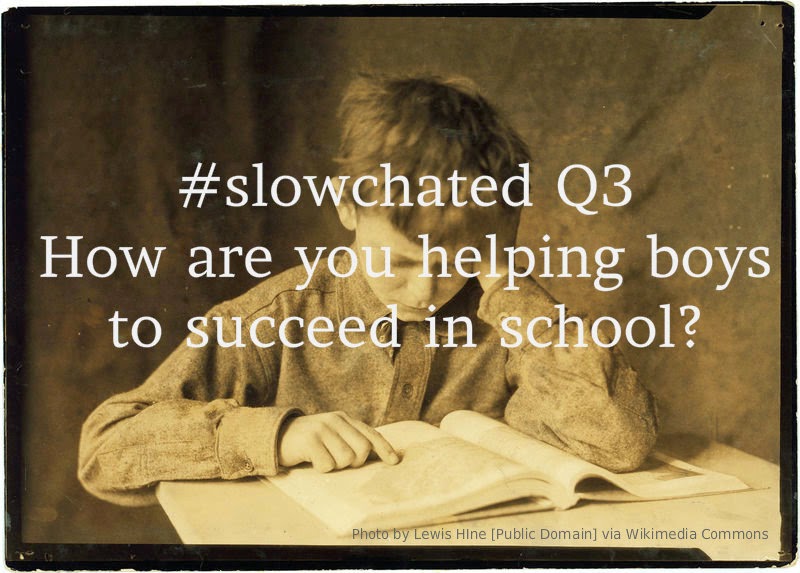
After spending two days discussing the problem, it was time to look for solutions.
Interestingly, no one mentioned something specific they were doing for boys. All of these strategies would benefit all students. The key seems to be breaking away from the traditional teacher lectures/student listens model.
A3 #slowchated Model/mentor positive behavior. Unique for me having gone to school I teach at. Show Ss ok to be good academic/athlete
— Mr.Allard (@MrAllardSS) April 8, 2015
A3: I am helping boys in the classroom by giving them a sense of power and ownership in what they do and creat. #slowchated
— Angela Breneman (@teachlove4SpEd) April 9, 2015
A3: positive and well designed competition important too. Yee's gamification player types suggests boys engage dif than girls #slowchated
— Adam Powley (@MrPowley) April 9, 2015
Our fourth question went back to the big picture.
Again, the suggestions were not specific to boys. When schools better meet the needs of all learners, boys' performance and school experience will improve, too.
A4 Schools need to adapt to be more Ss centered period, w/o a specific focus on boys or girls. #slowchated
— Beth Crawford (@bethctech) April 9, 2015
A4: I think we need to do a little of both, and meet in the middle. The whole system needs to change to meet diverse students #slowchated
— Mari Venturino (@MsVenturino) April 10, 2015
A4 I put all the onus on the schools, given what we know about kids. We need to adapt to them, rather than expect the opposite. #slowchated
— Moss Pike (@mosspike) April 10, 2015
A4 #slowchated
I think early childhood ed is key. Ss need time to learn through play - not high stakes kindergarten.
— Jim Windisch (@TeacherWithTuba) April 10, 2015
I ended the week with a question I think about frequently as a male elementary school teacher. I've never worked (or attended) an elementary school with more than three male teachers. I've always felt that some boys get the idea that school and education is a female pursuit when they don't see men teaching classes. Being the Friday question, there weren't too many responses, but I think the one below says it all.
A5: A person once told me in order for a boy to become a man he must first see one. #slowchated
— WalterReap (@WalterReap) April 10, 2015
Male role models are important, whether or not they're found in schools. Still, this is an idea I would like to explore more, so I might dedicate an entire chat to this topic in the future.
Thanks to everyone who participated this week. I enjoyed seeing the thought put into the answers for this topic. I look forward to more discussions of big ideas with #slowchated
"The Dunce" by Harold Copping [Public domain], via Wikimedia Commons
At first I wondered if all of these statistics were telling the truth. As a fifth grade teacher, I never noticed a gender gap in my classroom. I've had high performing boys and girls. I've also had just as many girls as boys requiring additional academic support through remediation and special education programs. Then I thought about it some more. In 12 years of teaching, I can only think of two girls who had an out of school suspension, but every year at least two boys from my classroom were suspended at some point during the school year. Nearly every time a student surprised me with uncharacteristically poor performance on a standardized test it was a boy. The students I've hounded most about homework, my least motivated readers, my students who required in-class aides: all boys. Something is going on here. And it isn't just a problem in the United States. Finland, who is often held up as a model of a successful school system, has twice the gender gap of the United States on the reading portion of the National Assessment for Education Progress.
What is causing these problems? Is it the way our schools are run? A Time Magazine article suggested that teachers discriminate against boys. Do we? Or is it boys themselves? Does the development of the male brain differ so much from the female brain to account for these statistics? How can we, as educators, address these issues?
All of these thoughts about boys in school led me to think about the men in my school. I've taught at two different elementary schools and had the distinction of being the only male classroom teacher in the building. Now that I'm the advanced learning specialist, there aren't any male classroom teachers in my building. How does the lack of male teachers in elementary schools affect boys? Current statistics show that men make up only 19% of the entire elementary and middle school teaching force. Could that be part of the problem of boys' underachievement? How can we encourage more men into our profession?
This isn't exactly an opening statement for the chat since we've already been discussing this topic for two days. Every Tweet and every link is giving me more to think about. I jotted down potential questions for the week when I signed up to moderate, but all of the great information we're discussing leads me down different paths. So I won't be posting questions in advance.
Please keep sharing, and remember that the beauty of a slow chat like this is having the freedom to take time. Explore the posted links, find additional statistics and articles to share, and engage with the rest of the #slowchated community. I look forward to seeing what you contribute.
I've been home from the NCCE-Northwest Council for Computer Education conference for two weeks, and my head is still spinning with all of the educational awesomeness I encountered there. It was my first time at a big education conference, and I did my best to take it all in. I attended 14 sessions and workshops and kept up with countless more via Twitter. I walked every aisle of the exhibit hall, and spent all of my free time connecting with inspiring educators from around the country.
New Tech Ideas
Collaboration is the big idea in education right now. I learned strategies for managing collaborative work in Google Drive including having students experiment with collaborative documents by starting with a spreadsheet with their own assigned rows (thanks Nikki Robertson). Cheryl Steighner hosted a terrific session about Google in elementary schools. One of her ideas is to have a collaborative story that students can add to over time. She has one story that students have continued even two years after leaving her classroom! Throughout my time in Portland, I heard about countless apps, websites, and tools that I will be exploring for months to come.
Connections
As great as the official sessions and workshops were, the best part of attending NCCE was connecting with other educators. There were quite a few sessions about how important it is to build a personal learning network (PLN) through Twitter or another social learning platform. I am a full-fledged Twitter evangelist, and my time at NCCE proved why. Everywhere I went, I ran into people I already knew. We were able to jump in and discuss because we already knew each other's backgrounds. I added many more educators to my PLN so I could continue to learn from them after NCCE.
Excuse the random
photo, but the mens'
rooms in the Portland
Convention Center have
amazing artwork!
One highlight of connecting at NCCE was Wednesday's #IDedchat. We met at a swanky, 30th story bar in downtown Portland to discuss professional development. It was a little strange staring at our phones to chat online when we were in such a beautiful place with great company, but being together created a more festive atmosphere for the chat. Plus, most of us arrived early to share dinner and chat.
I also got to have a wonderful lunch with Cheryl Steighner to discuss tubas and elementary education, and I spent a night on the town with some of my colleagues from Coeur d'Alene (Kelli Ogle and Kiersten Kerr are the only ones on Twitter) and Nikki Robertson from Alabama. I also got to chat with one of the most inspiring bloggers I know, Steve Wyborney, in the exhibit hall. Those informal learning moments were the best of the conference!
Now it's time to put what I've learned in to action. On Monday, I'm hosting a Monday Morning Appy Hour at my school to share some of the iPad apps I learned, and I'm working many of the other ideas I learned into upcoming lessons. It also sparked a desire to attend (and possibly present at) other big conferences. We'll just have to see where that leads, and I'll keep you updated as I continue to experiment and refine...
I took great pride in my work for elective classes in high school: often more than I did for my academically required courses. I played tuba in multiple bands, acted in most of our school plays, competed in speech and debate, and wrote for the school newspaper. Now, of course, the fact that I chose my electives was a motivator, but the biggest difference between those classes and my others was the audience. I knew that my work would be on display for my peers and the larger community, not just the teacher. I practiced and practiced the tuba solo in the Holst Suite because I knew how many people would be listening. I carefully revised and edited every submission I wrote for the Timberwolf Times because all of my friends and teachers would read my work. I did fine on the papers that I wrote for my teachers' eyes only, but I rarely put the same type of effort into those assignments.
Coursework in the arts and many electives has always given students an authentic audience, while work in other classes is done solely for the instructor. Why? Personally, it wasn't something I thought about much until recently. In the past, I had my students imagine an audience for their writing, but we rarely wrote for a real audience. This year, I'm starting to give my students real audiences for presenting their work. I've seen how sharing their work with a broader audience motivates and inspires many of my students. Still, I know I can do more and I want to hear your ideas.
These are the questions I have in mind, but they are subject to change as you contribute ideas throughout the week.
Q1 What makes an audience "authentic"?
Q2 How do your students create for authentic audiences?
Q3 How much audience participation do you want? How do you encourage or discourage it?
Q4 What is something you already do that could be enhanced with an authentic audience?
Q5 Where do you find an audience?
Q6 What is your "dream audience" for student work?
I'm eager to discuss this with you on #slowchated and I hope that you will take full advantage of the slow chat format. We have a whole week to find and post links, photos, and blog posts. Best of all, we have an authentic audience in each other, and audience participation is required. Ask questions, challenge assumptions, and learn from one another!
A few years ago, I decided that I needed to bring fun back into my classroom. All of the pressure to perform on the test, direct instruction initiatives, and fidelity to adopted curriculum was pushing the joy out of my classroom. I happened to grow a winter beard that year and it needed some trimming by mid-February. Since Presidents' Day was just around the corner, I decided to ditch the moustache in favor of Abraham Lincoln's famous chinstrap. Next thing I knew, I was wearing my top hat and posing for pictures to share with my students. They had a laugh at my expense and it sparked some conversations about U.S. History. A fun tradition for my classroom was born.
Each year since, I've been growing "facial hair of the presidents" to celebrate the big day in February. Chester A. Arthur's friendly sideburns followed Lincoln. Then, last year, a friend sent me an inspiring article about a high school student who took photos as all of the presidents. I knew I had to go for it, but I would keep my pace of one per year. A little calculation made me realize I would be in my seventies by the time I finished. I want to complete this project before retirement, so Rutherford B. Hayes and William Howard Taft ushered in an era of double duty for me.
This year's portraits of James A. Garfield and Theodore Roosevelt probably mark the end of bearded and mustachioed presidents for awhile. We'll all have to wait for next year to see how I do at clean-shaven presidential impersonation.
Since joining Twitter, #SlowChatEd has been one of my favorite hashtags. Since it runs for an entire week, it was always a little different than the other, sometimes frantic Twitter edchats I join in on. But when the school year started, #SlowChatEd disappeared. I figured it went on a short hiatus while the usual moderators were "September busy." The hiatus dragged on, and #SlowChatEd slipped to the back of my mind.
Then, a couple weeks ago, Ross LeBrun revived #SlowChatEd to talk about being thankful. Although I couldn't participate for the entire week, I was reminded how much I liked the slow chat format. So, this coming week I plan to hijack (I mean moderate) #SlowChatEd to talk about "making ideas real."
As I've shared before, joining Twitter has done wonders for me as a teacher. Before Twitter, I was still an avid reader of big education websites like Edutopia and a few teacher blogs. I attended conferences and professional development classes whenever I got the chance and I was always looking for new ideas in my classroom. When I hear a great idea, I want to put it into action right away! Sometimes, though, I had so many great new ideas that I just couldn't make them work. Being on Twitter has only made it worse - my TweetDeck columns are never-ending waterfalls of new ideas. How can I make the best of these ideas into reality?
I'll be posting one question or prompt each day for the next week. Since it is a slow chat, please feel free to respond in multiple tweets, post links to resources, and ask questions of the other participants. Here are the questions:
Monday: Share an idea you recently implemented in your school.
Tuesday: What are your favorite sources for new ideas?
Wednesday: How do you manage the flow of ideas?
Thursday: Share an idea you are working on now. How are you moving from idea to reality?
Friday: How can we support each other and our colleagues to implement new ideas?
I have a few follow-up questions in mind for some of the days, too. I hope this will be a valuable discussion and I hope to see you there!




.jpg)