Showing posts with label Twitter. Show all posts

Wednesday, June 22, 2016

#IDedchat: Summer reading June 22, 2016


This week, I'll be hosting #IDedchat along with Sarah Windisch. It's summer, and that means we finally have time to sit down and read. I know my summer reading is always a mix of professional books, KidLit, pulp novels, and internet articles. Even though my to-read list is endless, I'm still always looking for recommendations.

Tonight, let's give each other some recommendations for summer reading. We will try to just have an open discussion and just throw out ideas from our own diverse reading lists. Think about the questions below to guide our discussion, and Sarah and I will throw them out throughout the chat if we need to keep the discussion moving.

I hope you'll join us tonight, and I really look forward to hearing your recommendations!

Summer Reading
June 22, 2016
7 p.m. PDT / 8 p.m. PDT / 9 p.m. CDT / 10 p.m. EDT

Some of these questions come from a chat that I hosted for the gone, but not forgotten, #slowchated

What are you currently reading?
Which book do you most recommend for other teachers?
What is your all-time favorite book?
 Share something you read as a student that sticks with you to this day.
Why did it make an impact?
Share something you read that inspired a change in your practice this school year.
 Share something you have read and are still digesting.
 What do you most want your students to read?


Sunday, February 14, 2016

Inspiration from #IETA16

My head is still swimming from all the education awesomeness I experienced at my first Idaho Education Technology Association (IETA) Conference. Between the sessions, exhibit hall, and networking, it was one of the best conferences I've attended. Rather than leaving with a mile-long wishlist of technology, I have ideas that I can use in my classroom and share with my colleagues.

I was lucky enough to attend along with my wonderful wife, Sarah Windisch. Since we're both always looking for ways to improve our schools and classrooms, the learning never stopped. We're still talking about all of the things we're inspired to try out.

Monday opened with Darren Hudgins' keynote presentation "The Merchant of Someday." He highlighted just how rapidly access to information and communication is changing the world.
Although the world has changed immensely in the last few years, schools have been much slower to adapt. He challenged us to use our vision of someday to guide us as we sell learning to our students. It definitely set the right tone to kick off a technology conference.
I also got to learn about Hyperdocs from Lisa Highfill on Monday. The basic idea of Hyperdocs is to create an all-in-one digital document that gives students the instructions and resources to explore and learn on their own. Then students can share the basic information with each other online leaving your class discussion time for making meaningful connections and digging deeper. This was my biggest takeaway from the conference. I'm putting this right to work in my classroom for third grade literature circles. I also loved hearing about Lisa's Teachers Give Teachers Twitter account. It's basically a repository for re-tweeted free resources from other teachers. It's a great concept, and I hope it really takes off in Idaho.

The #IDedchat crew got together Monday night. Discovery Education hosted a nice reception for the group and it was fun to spend some time with my usually virtual PLN.
My favorite Tuesday session was almost another keynote as Rushton Hurley talked about making memorable projects. He encouraged us to get students asking interesting questions.
When students are interested, they're willing to produce excellent work. In addition, constructing a memorable project sets the stage for greater student learning.
The rest of the second day was full of great ideas, too, but the highlight was the IETA Teacher of the Year award. It went to a fourth grade teacher from my district who has done some amazing things with technology in her classroom. I always look forward to learning with her at our district technology meetings. Congratulations, Kelli Ogle!

There were so many things at IETA that I want to bring back to my classroom. It will definitely keep me trying new ideas through the rest of this school year and beyond. And I'll keep you updated as I continue to experiment and refine...

For more #IETA16 learning, check out Janet Avery's Storify of Day 1 and Day 2.

Sunday, April 12, 2015

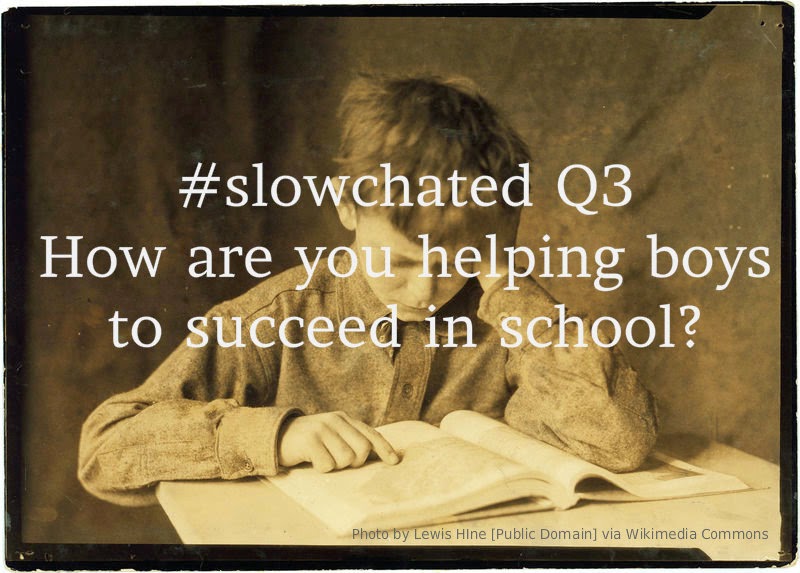
Sunday Summary: Boys & Men in Education #slowchated

After a week of discussing boys and men in education, I have even more questions than I did when I started. The biggest of those questions is how I should respond to the statistics that show boys struggling in schools. It's important to not generalize from the statistics: to continue to be responsive to the students in front of me, not the "average student" presented by the numbers. Still, the statistics concern me. How can we make school better for boys and boys better for school? Here is a selection of tweets from the week to assist you in finding your answer to that question.

I started the week with a cold opening. I hoped this question would elicit some emotion and strong opinion.
The answers ranged from uncertainty over whether this claim was true to collections of links about boys performance in school. Most responses, however, shared observations that may point to the problem.


And my first question also brought back the first reminder that we must be careful with these statistics to avoid stereotyping our students.

When I reflected on the statistics shared in my opening statement and from various tweets on Monday, I realized that I had seen many of the behavior statistics play out in my classroom (more frequent suspensions and discipline infractions related to bullying), than I had academic differences between boys and girls. That led to this question:


All of those tweets began to point at the problem, but the next ones really summed it up for me.


I've seen just as much inappropriate behavior from girls as boys, but boys are more likely to break a big school rule that results in harsh consequences like suspension. For example, bullying seems to happen equally with boys and girls, but boys' bullying is more likely to get physical and our school rules are clear that physical aggression results in suspension. Although the humiliation that can come with name-calling and rumors is just as damaging, if not more so, it is more difficult to determine when those behaviors warrant severe consequences.

After spending two days discussing the problem, it was time to look for solutions.
 Interestingly, no one mentioned something specific they were doing for boys. All of these strategies would benefit all students. The key seems to be breaking away from the traditional teacher lectures/student listens model.


Our fourth question went back to the big picture.
 Again, the suggestions were not specific to boys. When schools better meet the needs of all learners, boys' performance and school experience will improve, too.


I ended the week with a question I think about frequently as a male elementary school teacher. I've never worked (or attended) an elementary school with more than three male teachers. I've always felt that some boys get the idea that school and education is a female pursuit when they don't see men teaching classes. Being the Friday question, there weren't too many responses, but I think the one below says it all.
Male role models are important, whether or not they're found in schools. Still, this is an idea I would like to explore more, so I might dedicate an entire chat to this topic in the future.

Thanks to everyone who participated this week. I enjoyed seeing the thought put into the answers for this topic. I look forward to more discussions of big ideas with #slowchated

Tuesday, April 7, 2015

Boys & Men in Education #slowchated April 6 - 11

Boys are 22% more likely to repeat a grade than girls.
For every 100 girls diagnosed with a learning disability, 276 boys are diagnosed.
For over 50 years, girls have outperformed boys on standardized tests measuring reading ability.

"The Dunce" by Harold Copping [Public domain], via Wikimedia Commons
At first I wondered if all of these statistics were telling the truth. As a fifth grade teacher, I never noticed a gender gap in my classroom. I've had high performing boys and girls. I've also had just as many girls as boys requiring additional academic support through remediation and special education programs. Then I thought about it some more. In 12 years of teaching, I can only think of two girls who had an out of school suspension, but every year at least two boys from my classroom were suspended at some point during the school year. Nearly every time a student surprised me with uncharacteristically poor performance on a standardized test it was a boy. The students I've hounded most about homework, my least motivated readers, my students who required in-class aides: all boys. Something is going on here. And it isn't just a problem in the United States. Finland, who is often held up as a model of a successful school system, has twice the gender gap of the United States on the reading portion of the National Assessment for Education Progress.

Photo by deradrian via Flickr
What is causing these problems? Is it the way our schools are run? A Time Magazine article suggested that teachers discriminate against boys. Do we? Or is it boys themselves? Does the development of the male brain differ so much from the female brain to account for these statistics? How can we, as educators, address these issues?

All of these thoughts about boys in school led me to think about the men in my school. I've taught at two different elementary schools and had the distinction of being the only male classroom teacher in the building. Now that I'm the advanced learning specialist, there aren't any male classroom teachers in my building. How does the lack of male teachers in elementary schools affect boys? Current statistics show that men make up only 19% of the entire elementary and middle school teaching force. Could that be part of the problem of boys' underachievement? How can we encourage more men into our profession?

This isn't exactly an opening statement for the chat since we've already been discussing this topic for two days. Every Tweet and every link is giving me more to think about. I jotted down potential questions for the week when I signed up to moderate, but all of the great information we're discussing leads me down different paths. So I won't be posting questions in advance.

Please keep sharing, and remember that the beauty of a slow chat like this is having the freedom to take time. Explore the posted links, find additional statistics and articles to share, and engage with the rest of the #slowchated community. I look forward to seeing what you contribute.

Monday (4/6/2015)
 Tuesday (4/7/2015)
 Wednesday (4/8/2015)
Thursday (4/9/2015)
Friday (4/10/2015)


Saturday, April 4, 2015

Inspiration from #NCCE2015

Image from blog.ncce.org
I've been home from the NCCE-Northwest Council for Computer Education conference for two weeks, and my head is still spinning with all of the educational awesomeness I encountered there. It was my first time at a big education conference, and I did my best to take it all in. I attended 14 sessions and workshops and kept up with countless more via Twitter. I walked every aisle of the exhibit hall, and spent all of my free time connecting with inspiring educators from around the country.

New Tech Ideas
Collaboration is the big idea in education right now. I learned strategies for managing collaborative work in Google Drive including having students experiment with collaborative documents by starting with a spreadsheet with their own assigned rows (thanks Nikki Robertson). Cheryl Steighner hosted a terrific session about Google in elementary schools. One of her ideas is to have a collaborative story that students can add to over time. She has one story that students have continued even two years after leaving her classroom! Throughout my time in Portland, I heard about countless apps, websites, and tools that I will be exploring for months to come.

Connections
As great as the official sessions and workshops were, the best part of attending NCCE was connecting with other educators. There were quite a few sessions about how important it is to build a personal learning network (PLN) through Twitter or another social learning platform. I am a full-fledged Twitter evangelist, and my time at NCCE proved why. Everywhere I went, I ran into people I already knew. We were able to jump in and discuss because we already knew each other's backgrounds. I added many more educators to my PLN so I could continue to learn from them after NCCE.

Excuse the random
photo, but the mens'
rooms in the Portland
Convention Center have
amazing artwork!
One highlight of connecting at NCCE was Wednesday's #IDedchat. We met at a swanky, 30th story bar in downtown Portland to discuss professional development. It was a little strange staring at our phones to chat online when we were in such a beautiful place with great company, but being together created a more festive atmosphere for the chat. Plus, most of us arrived early to share dinner and chat.

I also got to have a wonderful lunch with Cheryl Steighner to discuss tubas and elementary education, and I spent a night on the town with some of my colleagues from Coeur d'Alene (Kelli Ogle and Kiersten Kerr are the only ones on Twitter) and Nikki Robertson from Alabama. I also got to chat with one of the most inspiring bloggers I know, Steve Wyborney, in the exhibit hall. Those informal learning moments were the best of the conference!

Now it's time to put what I've learned in to action. On Monday, I'm hosting a Monday Morning Appy Hour at my school to share some of the iPad apps I learned, and I'm working many of the other ideas I learned into upcoming lessons. It also sparked a desire to attend (and possibly present at) other big conferences. We'll just have to see where that leads, and I'll keep you updated as I continue to experiment and refine...

Monday, March 9, 2015

Authentic audiences #slowchated March 9 - 15, 2015

Image from Wikimedia Commons
I took great pride in my work for elective classes in high school: often more than I did for my academically required courses. I played tuba in multiple bands, acted in most of our school plays, competed in speech and debate, and wrote for the school newspaper. Now, of course, the fact that I chose my electives was a motivator, but the biggest difference between those classes and my others was the audience. I knew that my work would be on display for my peers and the larger community, not just the teacher. I practiced and practiced the tuba solo in the Holst Suite because I knew how many people would be listening. I carefully revised and edited every submission I wrote for the Timberwolf Times because all of my friends and teachers would read my work. I did fine on the papers that I wrote for my teachers' eyes only, but I rarely put the same type of effort into those assignments.

Coursework in the arts and many electives has always given students an authentic audience, while work in other classes is done solely for the instructor. Why? Personally, it wasn't something I thought about much until recently. In the past, I had my students imagine an audience for their writing, but we rarely wrote for a real audience. This year, I'm starting to give my students real audiences for presenting their work. I've seen how sharing their work with a broader audience motivates and inspires many of my students. Still, I know I can do more and I want to hear your ideas.

These are the questions I have in mind, but they are subject to change as you contribute ideas throughout the week.   

Q1 What makes an audience "authentic"?
Q2 How do your students create for authentic audiences?
Q3 How much audience participation do you want? How do you encourage or discourage it?
Q4 What is something you already do that could be enhanced with an authentic audience?
Q5 Where do you find an audience?
Q6 What is your "dream audience" for student work?

I'm eager to discuss this with you on #slowchated and I hope that you will take full advantage of the slow chat format. We have a whole week to find and post links, photos, and blog posts. Best of all, we have an authentic audience in each other, and audience participation is required. Ask questions, challenge assumptions, and learn from one another!

Monday, January 19, 2015

#SlowChatEd For the love of reading...

Once again, I'll be hosting #SlowChatEd Hopefully you can join us for this week's chat. (January 20-24, 2015)

Image from Personal Excellence

Reading. It's the key to much of what we do as educators. Even the subjects that aren't about "learning to read" such as Math, Science, and Physical Education still require "reading to learn." And, of course, reading isn't just about books. Reading is the key to digital learning, too. Heck, you're reading right now so you will know what is happening when you read the #SlowChatEd tweets all week.

How do we become readers? How can we encourage our students to become readers? We'll spend the week sharing titles and links to books, articles, and blog posts. Hopefully, these examples will reveal some of our personal experiences as readers and the experiences we create for students to turn them on to reading.

Image from Wikimedia Commons

After last week's Fortunately...Unfortunately chat, I want to continue the great interaction and depth the #SlowChatEd community brought to those topics. So, I challenge you to ask each other questions, reveal your answers a little at a time, and have some fun while you're learning.

There is also a special assignment this week. During last week's chat, Lindsey Lipsky reminded us about the great READ posters of days past.


Sometime this week, make your own READ poster or find a favorite vintage one and share it with all your #SlowChatEd friends. If you post the best one, you'll be temporarily crowned emperor of the EduTweeters. It should be a terrific week, and I look forward to learning from all of you!

Your host for the week,

-Jim Windisch

Cross-posted to slowchated.wordpress.com

Saturday, December 6, 2014

Making ideas real: #slowchatED December 8-12

Since joining Twitter, #SlowChatEd has been one of my favorite hashtags. Since it runs for an entire week, it was always a little different than the other, sometimes frantic Twitter edchats I join in on. But when the school year started, #SlowChatEd disappeared. I figured it went on a short hiatus while the usual moderators were "September busy." The hiatus dragged on, and #SlowChatEd slipped to the back of my mind.

Then, a couple weeks ago, Ross LeBrun revived #SlowChatEd to talk about being thankful. Although I couldn't participate for the entire week, I was reminded how much I liked the slow chat format. So, this coming week I plan to hijack (I mean moderate) #SlowChatEd to talk about "making ideas real."

As I've shared before, joining Twitter has done wonders for me as a teacher. Before Twitter, I was still an avid reader of big education websites like Edutopia and a few teacher blogs. I attended conferences and professional development classes whenever I got the chance and I was always looking for new ideas in my classroom. When I hear a great idea, I want to put it into action right away! Sometimes, though, I had so many great new ideas that I just couldn't make them work. Being on Twitter has only made it worse - my TweetDeck columns are never-ending waterfalls of new ideas. How can I make the best of these ideas into reality?

Image by nocturnal~schism
I'll be posting one question or prompt each day for the next week. Since it is a slow chat, please feel free to respond in multiple tweets, post links to resources, and ask questions of the other participants. Here are the questions:

Monday: Share an idea you recently implemented in your school.

Tuesday: What are your favorite sources for new ideas?

Wednesday: How do you manage the flow of ideas?

Thursday: Share an idea you are working on now. How are you moving from idea to reality?

Friday: How can we support each other and our colleagues to implement new ideas?

I have a few follow-up questions in mind for some of the days, too. I hope this will be a valuable discussion and I hope to see you there!

Monday, July 28, 2014

Inspiration from Edcamp Idaho

This has been a tough post to write, I really don't know how to describe my experience at the first Edcamp Idaho.  My son (almost 4 years old) helped me. He said I should write:

Camp was fun! Everything there was so much fun!

His words pretty much cover it, but I'll try to elaborate. When I first heard about it, I was afraid I wouldn't be able to go. Although it was my state Edcamp, it was a long way away. I took the plunge and made the 11 hour drive to be there.

Photo by Simon Miller
The night before the event, quite a few #IDedchat participants met for a Tweetup at a local restaurant. My main goal for the trip was to meet members of my personal learning network face to face and this would be my first opportunity. It was a little surreal meeting people I had never met before, yet they knew me by name before we even said hi. We were able to chat, share some food, and play bocce. If there is ever an inter-state edchat bocce competition, I wouldn't bet against the Idaho team (as long as I wasn't playing - my bocce game still needs some work).

Everyone was excited to be there to share ideas, and they were all unbelievably helpful and friendly. Being at the other end of the state, I only knew one other person there. Simon Miller is a technology coordinator from Kellogg, Idaho who I first met at a Google Apps for Education Festival this winter. He helped arrange accommodations for me in Hailey. I also met my host for the night, Dave Guymon. He just moved to Hailey to take a job with their school district and graciously offered a place for Simon and I to stay the night (and he cooked us a hearty breakfast before our day of learning). Tim Rocco was kind enough to supply us with sleeping bags for the night. In addition to the effort those three put into making sure I had somewhere to sleep, everyone else at dinner instantly made me feel at ease and comfortable. I met four more members of my PLN: Tami Rigby, Marita Diffenbaugh, Janet Avery, and Chad Avery. There were plenty of teachers who weren't on Twitter (yet) who joined in our conversations that night.

Edcamp Idaho session board photo by Janet Avery
Since I was staying with some of the organizers, I was one of the first to arrive at Wood River High School in the morning. I met Maggie Stump, who has been an active participant in our Teach Like a Pirate book study, right away. Excited educators kept streaming in and voting for the day's topics. One of the great things about edcamp is that all of the sessions are completely participant created and driven. For Edcamp Idaho, most of the session ideas were proposed ahead of time and participants were able to place stickers on the topics they wanted included in the day's agenda. When the session board was posted, there were 36 sessions to choose from with topics ranging from encouraging students to read non-fiction to learning how to use specific technology resources.

My first session was Teach Like a PIRATE. Although only a handful of teachers in the room read the book, we had a great discussion on the importance of rapport and a lot of ideas shared for transforming classrooms. I went to sessions on favorite classroom apps and using Discovery Education, but my favorite session of the day was "Things That Suck." That session presented us with controversial education topics and everyone in the room physically arranged themselves in order from strong agreement to strong disagreement and then we debated. I found that I was frequently in the middle, but there were many passionate arguments for and against merit pay, high-stakes testing, and homework. I was surprised by the diversity of opinions in the room.

Hanging out with other edcampers - photo by Marita Diffenbaugh
Edcamp Idaho was everything I hoped it would be and more. With over 100 teachers in attendance and 36 sessions, I'm still sorting out everything I learned. I have a huge list of apps to check out, some resources to investigate for project-based learning, and ideas for getting my students started with Google Apps. I even won a year subscription to Nearpod! But by far the most valuable part of Edcamp Idaho are the connections I made. As great as building my Twitter PLN has been, meeting face to face is amazing. I guess the best way to wrap it all up is by saying: Camp was fun! Everything there was so much fun!


Friday, July 11, 2014

Twitter rescued me

I'll come right out and say it. I was burnt out. Somewhere along the way, I lost that spark that made me a teacher. There are so many reasons why it happened: The constant battle with the state legislature for adequate funding and fair treatment. The isolating feeling of being the only male teacher in my school. The sudden shift to new standards. So many little things that just made it harder and harder to be enthused about my work.

I knew that I wasn't doing my best teaching anymore. I was ashamed. I felt like a failure knowing that my attitude could prevent some of my kids from having the best fifth grade year possible. It seemed as though I had no one to turn to. I was uncomfortable talking to teachers who always seemed to be doing great because I didn't want them to know how I was feeling. If I talked to other teachers who were having a rough year, it became a festival of complaint. All of that just made my burnout worse and worse.

Illustration by Sarah Windisch (@slwindisch)
In February, a college friend of mine mentioned how much he enjoyed his state edchat. I had a Twitter account I never used, so I thought I would check things out. In a few minutes I discovered an upcoming Google Apps for Education Festival in my area. I secured a last-minute registration for the GAfE Festival, knowing that I needed something to inspire me. I gained some new ideas from the sessions at the festival, but the most valuable experience came after the event. The organizers invited everyone to meet later that night at a local pub for an after-party. That night, I connected with teachers throughout the West who were doing amazing things. In addition, they talked about how much they learn from Twitter.

Later that week, I made sure to participate in #IDedchat on Twitter. The topic was ideas for successfully implementing the Common Core Standards. I shared a few things that I had done, but mostly I learned that teachers from all over the state were coming up with ideas to implement the new standards even though they were struggling with the same problems of little training and insufficient materials that I was facing.

Over the next few weeks, I continued to participate with #IDedchat, but I also dropped in on #MTedchat, #NorCalChat, #SlowChatEd, #WyoEdChat, #nt2t and #WeirdEd. With each edchat, I met more teachers who were finding success in the face of obstacles and added them to my personal learning network.

I never mentioned my burnout to my PLN. It was my secret shame. But as I connected with more and more teachers, my enthusiasm and passion for teaching rekindled. I was trying new ideas like MysterySkype and Genius Hour with my students. I began sharing what I learned on Twitter and at the GAfE festival with my colleagues at school. Soon, new opportunities came my way: I was asked to be my building technology leader (an extra duty I had wanted for a long time), my principal approached me about teaching our school's advanced learning program for the coming year, I got to lead a session at EdCamp Spokane, and I facilitated a summer book study on Google+. In addition, I started blogging about my own experience as a teacher and even wrote a guest post for a summer Blog-a-thon. It was easy to forget that I had ever faced burnout.

My flame for teaching is burning the brightest it ever has! So, why bother sharing my story of burnout? Teaching is a tough job, and when someone faces the type of stress that comes with the job, burnout is always possible. Burnout carries such a stigma that I felt terribly ashamed for reaching that point. I was scared of how my colleagues in my own system would react if I admitted how much I was struggling. Yet, it was only after I connected with other teachers that I was able to overcome burnout. As teachers, we need to break the stigma associated with burnout and connect with our colleagues. I'm thankful that I found Twitter and some great professional development to light my fire, but the key was connecting with other educators and learning new ideas. We can do this in our own schools and districts. Please, reach out to the other teachers around you, especially those who are having a rough year. Be a sympathetic listener as they share struggles and ideas. You might be the light that rekindles a flame!


Wednesday, July 2, 2014

Tweetchat triumph

Tonight I followed two edchats simultaneously. I joined #WeirdEd talking about "The Whole Wide World" and #NDedchat discussing "Connections" It was my first attempt at dual chatting and I had a bit of beginners' luck! This is my Tweetchat Triumph:


What made this so great? It answered the second question from #WeirdEd


and #NDedchat AT THE SAME TIME!


I was feeling pretty good after that one! However, all that awesome broke the Interwebs. I lost my connection to the world wide web about ten minutes later and missed the end of both chats.

Tuesday, May 13, 2014

The exhilaration of sharing

Last week was an amazing one for me! On Monday, Edutopia tweeted a link to my "letter to me on my first day of teaching." Then it was re-tweeted and re-tweeted. Over 500 people read my work by the time I checked in at lunch. By the end of the week, it had over 1,000 page views. I haven't had that many people read something I wrote since my local newspaper published my winning Arbor Day sentence in 1st grade! Sharing with that many other educators was amazing!

I dropped in on #idedchat later in the week and when the topic of holding kids accountable when working in groups came up, I linked to a self-assessment I created earlier this year. I hoped this form that I had found so useful would help someone else.

Another Idaho teacher was looking for pros and cons of different devices for a 1:1 initiative. I shared the Google doc my school has been using to organize our data about device choices with him (and the rest of my Twitter PLN). At least five people added on to the information I already collected. Some of the comments were absolutely invaluable for our analysis. The simple act of sharing improved upon my work!

Since I started my career in education, I always admired those teachers who were constantly sharing their work. I was impressed by their kindness and concern for others. Now I see that they benefited from sharing as well: sharing is exhilarating!

To better share with my fellow educators, I've created a page of classroom resources. There are only a couple things there now, but I'll add more soon. I hope that you can find something there that is helpful to you. And I'll keep you updated as I experiment and refine...