Showing posts with label big idea. Show all posts

Tuesday, July 3, 2018

Innovation vs. Expectations

My podcast diet typically consists of the fun kids' science podcasts my kid can't get enough of, like Wow in the World and Brains On. On a rare solo drive this week, I listened to Rough Translation, a more mature offering, and it has filled me with questions. I strongly recommend listening to it (or reading the transcript) before you read the rest of this post.

What does this mean for all of the changes and innovations that are necessary to keep improving my practice as an educator? When I know that I am making improvements for my students, I need to have the courage to stick with it. I can't let the questions and scrutiny that comes with change cause me to roll back into the old way of doing things.

A few years back, I ran across a quote from Brian Tracy that basically said one hour of professional development reading per day could make someone an expert in their field within seven years. Most Americans spent seven hours a day going to school for at least 13 years. After all that time, they feel like experts in schooling and have definite expectations of what education should look like.

Innovation, by definition, doesn't conform to expectations. Education stakeholders are going to ask questions and have conversations about the innovations that don't conform to their expectations. Even if it isn't the intention, this scrutiny can lead teachers to have cold feet with their new ideas. In the case of Ghana's preschools, teachers continued to put up colorful posters and move out of the traditional rows of seats, but they stopped asking students the important questions that led to the gains in personal expression.

Students investigate
the concept of area
I've seen it in my community, too. All Idaho teachers are required to take a mathematical thinking course. Although teachers have been taking the course for around a decade, there hasn't been a big shift to the type of mathematical learning that the course advocated. I think a lot of this is due to subtle pressure from parents and the community to teach kids math in a familiar way.

Educating parents is difficult. My school hosted a math night last fall where I gave an opening talk to the families that attended. The big messages of my presentation were that anyone can learn math, counting on fingers is positive and helpful, and it is good to make mistakes. As soon as I was done talking, I sent the parents off to their children's classrooms. I now wonder what type of conversations happened in those classrooms as a result. It leaves me wondering how to best involve parents without creating anxiety about new approaches.

How can we engage all of our stakeholders in a way that allows innovation to thrive? Communicating with parents is an important part of the job, but all of the change and innovation over the last few years makes their expertise and expectations from their time as a student obsolete. I think this dichotomy between outdated expectations and moving forward quashes a lot of innovation in our schools. What is the balance between expectations and innovation? How can we honor all of our stakeholders while trying new and unproven ideas?

If you have thoughts and answers, I would love to hear them. I will continue to experiment and refine as I seek answers to my questions.


Wednesday, August 16, 2017

Hate is poison. Education is the antidote.

It's easy to say that white supremacists of all types are wrong and I do not support their ideology one bit, but it's hard to figure out what I can do about it. When I couldn't sleep last night, I looked to my past experiences and my community's history for answers.

I have lived in or around Coeur d'Alene, Idaho for my entire life. For most of that time, a white supremacist compound in nearby Hayden Lake cast a shadow over our town. I became aware of the aryan nations group when a bomb exploded less than 500 feet from my first grade classroom. A nearby business owned by a Jewish family was targeted when some members of the group used explosions to distract from their plans to rob a bank.

As I grew older, I remember occasionally seeing a swastika patch on someone's jacket in the grocery store. My response was always to move to another aisle as quickly as possible. There were times that their hatred became more visible. One day, the neighborhoods around my high school were leafleted with racist propaganda and some of my friends brought the papers to school. Some were laughing at the inappropriate jokes inside, but most were shaking their heads with disbelief. I was concerned about my friends who found it funny and remember telling them that the neo-nazis wanted to turn their laughter into hate.

Looking back, it wasn't hard to be honest with my friends about hate. My parents did a good job giving me the confidence to stand up for what was right, but my education deserves credit, too. To counteract the hate in our community, educators made an effort to teach love and acceptance for all, especially those who were different. My fifth grade class was one of the first to attend the long-running human rights celebration that we still hold today. Books like Number the Stars were part of the curriculum, and reading them led to discussions of the toll that hate takes. 

The final hate group march in Coeur d'Alene, 2004
Photo by Cole via Flickr
Our community did its best to avoid adding fuel to the fire. When hate groups marched downtown, movie theaters, the roller skating rink, and other businesses across town offered free alternatives in the hopes that no one would be on the sidewalks to see the brownshirts and klansmen pass by. Most people understood that the white supremacists craved conflict. It was better to turn our backs to them until we were able to drive them from our community.

That day came when they shot at a former elementary school classmate of mine and his mother. I was in college about 100 miles to the south, but I followed the story of how the aryan nations were forced to turn over their property after losing in court. The story is worth reading. "Welcome to Hayden Lake, where white supremacists tried to build their homeland" by Meagan Day is a good overview, and the Spokesman-Review has a number of articles if you're interested in digging deeper.

Of course, closing the aryan nations compound didn't remove hate or all white supremacists from our community. During my first round of conferences as a teacher, I found myself shaking hands with a man wearing a black jacket with the aryan nations symbol on one sleeve and two jagged images of the letter 'S' on the other. Sometimes I catch a student using hateful language or humor, and I find myself pulling him or her aside to talk about it. No matter what happens outside of school, hate is not welcome in my classroom.

I've come to the conclusion that the best way I can combat hate is with the way I teach. First, my classroom is a safe space for all. We work on how to listen to one another and solve problems together. Second, we get to know our fellow humans. As I build my classroom library, I strive to include books with characters that each of my students will identify with. I also intentionally pick books that will allow my kids to get in the heads of people who are very different from themselves. Good, diverse literature helps kids understand others without seeing them as "the other." We also reach out to the world through the Global Read Aloud, mystery location calls, and connections with our class blog. These actions have gone a long way toward inoculating my students from hate by increasing their empathy and understanding of others.

In addition, I plan to address hate when we encounter it in literature and current events. We need to have frank discussions about the hate that exists and how we can keep ourselves and our friends from allowing it to spread. My students need the courage to stand up to their friends when they notice hateful words or actions. I can't stop the white supremacists that take to the street, but I can make sure my students know better than to stand for it.

___
Note: excuse my lack of capitalization, but hate groups don't deserve to be proper nouns.

Saturday, July 1, 2017

Idaho Kids Vote Book Award year two

One of my students, Hattie, created the logo
Last summer at this time, KidsVoteAward.com was still a week away from becoming a registered domain name. I wanted to get my kids talking and sharing about the books they read and reading more complex books. The idea of having a statewide book award had been bouncing around in my head since I saw displays for Oregon Battle of the Books and ORCA (Oregon Reader's Choice Awards) at Powell's books in Portland. That led to a flurry of activity for me that started in early July as I built the aforementioned website and began reaching out to others to make the Idaho Kids Vote Book Award a reality.
One of the inspiring displays

The premise of the award was simple. Teachers would nominate outstanding middle grade books that had been published in the last few years. They would then make these books available in their classrooms and encourage students to read about them. Kids would naturally talk about the books, but teachers could set up blogs and arrange connections with other participating classrooms to get the conversations flowing beyond classroom walls. Finally, in April, kids who read two or more of the books would vote to choose a winner.


With one year of the award completed, it's time to reflect and start thinking about the next one. Things went well in my classroom. Using my classroom budget and donations, I was able to get three copies of most of the books. There was buzz around them throughout the school year (especially the winning book). Although students talked about the books, not many chose to write about them when they created blog posts.

My students contributed one-sentence review blurbs to this bulletin board.
From the feedback I received, things did not go quite as well in the other 21 classes that signed up to participate. Few teachers were able to devote funds to buy all eight books. Others said their administration and district policies were roadblocks to connecting with other classrooms outside their district. Still, four classes contributed votes for the winner and suggestions for this year's award.

In the next few weeks I'll be ramping up for the second year of the Idaho Kids Vote Book Award. I'm presenting about it (and classroom connection strategies) at the P20 Conference at College of Southern Idaho. I'm also reading possible nominees for the award and hope to publish some book reviews here. Of course, there are some questions I still need to answer: How can we get nominated books into classrooms? What could remove some of the barriers to connecting classrooms? Is there a better way to make this accessible to students?

That's a lot to think about while I also catch up on household projects, work at my summer job, and take advantage of some extra family time I don't get during the school year. If you have ideas to help this succeed, please share. And I'll keep you updated as I continue to experiment and refine...

Saturday, March 18, 2017

Working toward empowerment: #IMMOOC Week 3, Post 3

I pride myself on having engaging classes. My room is a place for exciting projects, highly anticipated annual events, and connecting with other places via Twitter and blogging. Engagement hasn’t been my goal, though. I want my students to clamor for knowledge and understand how to drive their own education in my class and beyond. Chapter 6 of The Innovator’s Mindset has me wondering if I empower my students to reach that goal.

Right now, my 5th grade reading students are in the middle of creating curiosity projects. This is the fourth year I have attempted something inspired by Genius Hour. Some kids blow me away with their enthusiasm and deep learning as they take school time to write a short story or do research on one of their passions. Other kids seem to amass a folder full of gifs and memes related to their chosen topic, but show little evidence of new learning.

This taste of empowerment isn’t enough. My kids need more chances to take control of their learning so they can all use that freedom to do amazing things. I’m not quite sure what it will look like, but I can’t wait to get there!

Connecting and learning: #IMMOOC Week 3, Post 2

"What if we focused on connecting and learning, both globally and locally?" -George Couros, The Innovator's Mindset


Quote by Bill Nye
Image from The Good Men Project
Learning is a social pursuit. Every conversation, every book read, every YouTube video watched is an opportunity for learning from someone else. Occasionally we make an absolutely brand-new discovery, but the value of those discoveries increases once they are shared with others. This has been on my mind near-constantly since joining Twitter and making a point to share my learning online.

I encourage my students to learn from each other by sharing their thinking, engaging in Quality Boosters to improve their work, and looking to each other for help. There is a lot of connecting and learning that can happen within our own classroom.

If we can learn so much from the people within our classroom, think how much we can learn when we look for ways to connect beyond our classroom walls. We've connected with other classes to play mystery location games, share our thoughts about The Global Read Aloud Books, and learn from experts working in other places. We've also read and commented on blog posts while sharing ours with a larger audience. This is a good start, but how can I truly make connecting and learning a focus for my students?

Monday, March 13, 2017

Everyone learns, everyone teaches: #IMMOOC Week 3, Post 1

Image courtesy immooc.org
Why is there a divide between school and learning? How can we bring them closer together? A good place to start is recognizing everyone in the classroom as both teacher and a learner. I am proud to be a learner. When I try something new, I tell students. where I learned about it and that I am still figuring things out. My students know I learn in and out of school.


My students teach me and each other by sharing their thinking. Math classes begin with number talks or Estimation 180 challenges. These always put student thinking front and center. We learn from each other as we listen and consider different approaches. Throughout my classes, students share.

As I think about what I’m doing, I wonder how I can make it better. Do my students see themselves as teachers? I honestly don’t know. Even though they share their thinking, they look to me to bring it all together and make sense of it. How can we better share the responsibility of making connections and drawing conclusions from what happens in class? I guess I have a lot to learn as I head back to school this week...

This post is part of the Innovator's Mindset MOOC blogging challenge. You can find my other posts related to #IMMOOC here.

Wednesday, March 8, 2017

What is the Innovator's Mindset? #IMMOOC week 2

Image courtesy of immooc.org
Two weeks in, and The Innovator's Mindset MOOC is one of the best things I've done since deciding to take control of my own professional development three years ago. One of this week's blogging prompts was to choose one of the characteristics of the Innovator's Mindset and reflect on what that means for you. As soon as I looked at the sketchnote, I knew I couldn't limit my reflection to just one.


1. Empathetic

Trying to look at school (and especially your own class) with students' eyes can be scary. Does it seem like a safe place? Are the things we do motivating and inspiring? Is there value in what we are doing? I start doing this by picturing myself as a student, but I also ask students for feedback. My goal in this area is to offer more opportunities for truly anonymous feedback so I can better understand how my students feel about my classes.


2. Problem Finders

This is how I approach life. Question starts with quest because I am always setting off to find answers or solutions. Helping my students see questions has been a focus of my classes for awhile. My biggest success here has been with three act tasks. Having my students generate questions in math has been a game changer. My attempts at curiosity projects (I've also called it 20% time and passion projects) have always started with student questions as well. 

Speaking of curiosity projects, that is an area where I have lingering questions and answers to seek. It never works out as well as I want it to. That should be a topic for another blog post.


3. Risk Takers

"How you ever gonna know, if you never take the chance?" That line from one of my favorite Garth Brooks songs sums it all up. Ideas are great, but you need to act on them to really make a difference. I'm comfortable telling my students that I'm trying something new and I'm not sure if it will work. We frequently talk about the value of mistakes in my class, and I strive for an environment where no one feels their pride or dignity is at stake when they take a risk. Hopefully the only thing lost in failure is time and pencil lead, but the lessons learned will more than make up for that.


4. Networked

Joining Twitter was the best thing I ever did for my teaching career. Being in constant communication with other teachers inspires me to do better and gives me a sounding board for all of my ideas. 


5. Observant

As a teacher, my best information comes from watching my students. I'm not sure my students are great observers, though. I need to take the power of asking "What did you notice?" to more of my lessons.


6. Creators

This goes along with risk taking. You just need to go for it and put your idea in action. The Idaho Kids Vote Book Award is probably my most pressing example of using hard work to drive an idea and action to fruition. It's rewarding to see something come of your idea. Again, this is an area where I need to give my students more opportunities. There are many things created in my class, but more of them need to come from student ideas.


7. Resilient

Without resiliency, all seven of the other characteristics would fall flat. When things don't work out like you want, you have to be ready to pick yourself up and move forward. Maybe it's time to reflect and create another iteration. Maybe it's time to consider it a lesson learned and try something else entirely. Whatever the next step is, you can't wallow in failure. 

Things move fast in my classroom, and I think some measure of resiliency comes from not having the time to bog down and lament. Still, this can be a tough one, especially in my advanced learning program. Many of my students are used to doing well at everything they try in school. My classes challenge them and it can be uncomfortable. When I see a student reaching the frustration point where they just can't be resilient, it's time to step in and help with strategies like taking a break or taking stock of the places where they were successful. Hopefully those lessons continue with my students to other areas of their life.


8. Reflective

I'm writing this, aren't I? My moments of reflection come after every class, and sometimes I manage to get them written down here. For some reason, I have been stuck on the idea that reflection only counts when it is written down. As a result, my students' reflection often gets lost in the mechanics of putting words on a page. I'm trying to make more frequent, shorter reflection a priority. I was able to visit a classroom last week where students rated their learning and performance on a four-point scale throughout the day and had to think about what had to happen for them to move to the next level. That quick reflection was a powerful tool I plan to implement.

Saturday, March 4, 2017

Innovation is essential: #IMMOOC week 1

This is the first in a series of posts for the Innovator's Mindset MOOC. I looked like a bobblehead as I read the introduction to The Innovator's Mindset because I was nodding appreciatively to nearly every sentence. It looks like it will be a great book, and there is still time to join the free MOOC if you are interested.

Image courtesy of immooc.org
The purpose of education is to build kids into learners and intelligent consumers of information that can adapt to any situation. Our world is constantly changing. Many of the kids I teach will end up working in careers that don’t exist today. When we work to inspire a zeal for learning and help our students develop the tools to evaluate information, connect it to things they already know, and use mistakes to further their learning, we prepare them for whatever their future holds.
This was the last thing I wrote before picking up The Innovator's Mindset. Even though it doesn't contain the word innovation, it goes hand in hand with our purpose as educators. When the world changes, schools cannot be stagnant, nor can we expect them to be the sole source of our children's education. Giving students the tools to go on and self-educate requires us to be flexible. We need to adapt to our students' needs like we have always done, but we also have to take into account how our kids can use all of the resources available to meet their needs when they aren't in our classrooms. George Couros makes a great point about how we approach new tools in school in the Introduction to The Innovator's Mindset.
Think about it: we have the world at our fingertips. the ability to connect and create with people around the globe through so many different mediums. Yet what do most schools focus on when talking about technology? "Cyberbullying" and "digital safety." Yes, these are important concepts that should be discussed, but we need to go way beyond that. We are spending so much time telling our students about what they can't do  that we have lost focus on what we can do. (pg. 6-7)
Innovation is all about finding out what you and your students can do. There is absolutely a need to set boundaries, but we can't let them get in the way of the learning our students can do. One of my favorite lessons each year is figuring out the total number of gifts in "The Twelve Days of Christmas." I give my students just enough information to get started and then I get out of their way. They always impress me with the wide variety of strategies they use to figure out the answer. A couple years ago, I extended on this activity by asking them to figure out the approximate cost of the gifts in the 12 Days of Christmas. Since I didn't want my students to find the answer from the Christmas Price Index and I understood that some interpretations of "nine ladies dancing" might be school inappropriate, I gave them a list of sites to use for prices. After working on it for two days, I could see my students were bored and going through the motions without learning much. My fear of inappropriate content and desire to keep students from a readily-available answer cost us a chance for innovation. This year we explored the Christmas Price Index and students created lists of their own modern and extravagant 12 Days of Christmas. They were motivated, they explored, and the project was a success because it was an actual project, not an exercise with one correct answer.

I'd keep the Little Free
Library, but move it outside
One of this week's blog prompts was to share things to include (and leave out) if given the opportunity to develop a school from the ground up. If I were creating my own elementary school, I would begin with an environment where students felt safe and cared about. I am lucky to teach in a school that excels at this, and I think it is the foundation for success in elementary. As a result, I wouldn't change much from the current model of students in classrooms where they can work together with a teacher to build a community of trust, respect, and enthusiasm for learning. I would also continue to give students time with specialists in the arts and physical education. In fact, I would love students to have more time with these specialists and with a librarian who helps instill a love of books and reading.

My changes would be in the curriculum and how students share their work. Students need opportunities to use their curiosity. Every classroom would embrace curiosity projects or genius hour and give students time within the school day to explore their own interests. Not only does this give students the opportunity to bring what matters to them into the classroom, it provides real opportunities for them to practice the reading and writing skills they learn. Math instruction would include more problems with multiple answers and paths to get there. Students need opportunities to wrestle with ambiguity and develop their own problem-solving ideas rather than parroting back algorithms and defined steps for problem-solving.

The gallery at Mobius Spokane's previous location
looks like the perfect school museum space
The biggest difference between my school and most current schools would be a focus on sharing student work. I've always dreamed of having a school with an on-site museum that was open to the public outside of school hours. It would feature student-created exhibits of all kinds: art, history displays, interactive exhibits, video, and more in addition to temporary hands-on exhibits borrowed from other museums. There would also be a flexible performance space where students could present coffeehouse nights, stage plays and concerts, and hold town hall meetings. In addition to these opportunities to physically share their work with our immediate community, students would be able to share worldwide by posting work online and frequent communication with students in other places.

My school would challenge students, nurture their curiosity, and give them opportunities to engage in rich dialogue about their learning with others. I picture it as a place where students truly get to innovate as they get to use the things they learn to solve problems and make their own creations.


I had to share my #IMMOOC 
selfie here, too!
This is only a fraction of the thoughts in my head at the end of the first week of #IMMOOC. I can't wait to see where it goes from here!

Sunday, September 18, 2016

Can we talk about homework?

Me in first grade
Could you assign oppressive amounts
of homework to a face like that?
My introduction to homework came in first grade. Every school night, I had to write my numbers from 1 to 100, copy spelling words, and fill out some sort of worksheet. It took hours to complete: not because the assignment was difficult, but because I filled my time with distractions and dawdling to avoid the dreaded task. As I went through school, the assignments got better, but my attitude never did. I was a certified homework hater.

As a teacher, I found the other side of the homework situation wasn't much better. I did my best to assign meaningful practice in math and language arts, but it just didn't work. I found the students who most needed the practice didn't do the homework, often because they needed more assistance than they had at home. The students who reliably turned their homework in would have been better off using the time spent doing homework on reading or an extension activity. In addition, class time and relationships were sacrificed to extracting completed assignments from the kids who didn't get them done at home.

One of the benefits of switching from teaching fifth grade to my current position was that homework was not an expected part of my classes. The students who came to me were responsible for homework assigned by their regular classroom teacher, the time spent in my room was for enrichment.

Now that doesn't mean that I never wanted my students to take my class home with them. I challenge my kids to read 40 or more books a year: there isn't enough free reading time in the school day to make that happen. When my kids are confronted with a challenging idea in math or an argument from something they have read, I hope it's compelling enough that they will think about it overnight.

Last year, my entire school had a discussion about the necessity of homework. We read articles, surveyed families, and shared opinions about it. We didn't create a blanket homework or no homework policy, but an agreement that any homework assigned would be intentional and meaningful.

This week, my school's homework policy ended up on the front page of the Coeur d'Alene Press and in a KREM 2 News segment. It caused me to do even more reflection on how we want to build a bridge between school and home learning for our students.

This 3 topping pizza would cost 9.7¢ per
square inch at my favorite pizza parlor.

Image: Pizza Toscana in a box
[Public domain], via Wikimedia Commons
I want my students to continue thinking about what they've learned in school. When I show up dressed as Charles Pinckney on Constitution Day, I hope a few kids will go home and look up the text of the Constitution and learn more about the compromises made during the summer of 1787. If we calculate the cost per square inch of the Giant Sicilian pizza, a few of my kids are going to figure out the cost per slice of their family's dinner, right? If they want to break our class speed record for counting by 8s, won't my students practice at home?

The more I think about it, I don't know if my kids are taking their learning home with them. So, this year I plan to be more intentional about suggesting how they can practice, study, and engage in their own academic exploration after the bell rings at 3:30. No homework isn't the same as no learning at home.

In addition, I am going to encourage my students to take advantage of the enrichment opportunities available to them. Maybe less "homework" will mean more Invent Idaho projects, more entries in our local library's writing contest, and better preparation for our school spelling bee.

The big question is how to get that message to my students and their parents. How can I help my students become self-directed learners to the extent that they look for opportunities outside the school day? Do you have an answer? I'll be seeking them all year, and I'll keep you updated as I continue to experiment and refine...

Saturday, September 5, 2015

Getting ready

Another school year starts on Tuesday. Am I ready? I sure hope so. No matter what next week brings, I had a terrific week of getting ready for the new school year.

On Monday, my principal gathered our entire school staff for team building and goal setting at the North Idaho College Challenge Course. We've always had a tight staff, but it was amazing to see the trust exhibited on that ropes course. About half of us were willing to go up and try the high wires, rickety bridges, and swinging balance beams, but everyone took part hoisting ropes and working together on the ground-based challenges. It was the best start to teacher meetings I've ever experienced.

Tom Schimmer came to speak to all of our district's teachers about grading on Tuesday. He presented the idea of a standards-based mindset for grading. I really got a lot from his presentation, but the best were his explanations of summative vs. formative assessment that helped me understand the difference better than ever. We also received copies of How to Grade for Learning by Ken B. O'Conner for a district-wide book study. I'm excited to delve into this topic.


Speaking of book studies, my school staff read Dave Burgess's Teach Like a Pirate this summer. I read it the year before, but I was happy to share the experience with my staff. We had a pirate party to celebrate and discuss some of the ideas that came from reading it. Many of the teachers commented that the high school orientation of the book was difficult, but everyone came away with ideas for the coming school year. For me, the best part of our discussions was hearing about the plans to bring more joy into the classroom. The emphasis on testing and rigor has taken a toll on our kids and I'm glad to see our school focus on incorporating more fun and excitement into the good work we're already doing. I put up a Teach Like a Pirate bulletin board in our staff room with space for teachers to add notes about the ways the book affects their classrooms. I look forward to seeing what shows up there.

In addition to getting ready for the new school year as a teacher, I am the parent of a kindergartener this year. Thursday was kindergarten orientation for parents and our school's open house. Orientation was a remarkable event. My school's kindergarten team, Title I teacher, and district math coaches gave parents games and strategies to help their little guys succeed. We left the event with great information on assisting our son with handwriting, reading, and number sense. The evening's open house was a blast, too. It totally changed my perspective to experience this event as a parent. My son is lucky to have some friends from preschool in his class, because I think that helped put him at ease. He also got to meet his teacher, find his locker, and play on the playground. He seems really excited to start school next week: I'm the one who's nervous about it.

Finally, I was able to end the week with one of my favorite things: seeing and hearing live music. Sarah and I went to see Junior Brown in Spokane at Pig Out in the Park. I've loved Junior Brown's music since I was in high school. I saw him perform last time he visited the area nearly 20 years ago, when the world looked like this music video.

If it's possible, he was even better at playing the guit-steel this time around. The sounds he creates with his instrument are absolutely jaw-dropping. When we discussed it on the way home, we figured that he's had 20 more years of practice. I want to continue improving my practice as a teacher the way he has improved as a musician - maintaining my enthusiasm, experimenting with new techniques, and refining my craft. Here's to another year of practice!


Here's some more recent concert footage if you want to see what I mean about what happens with 20 years more practice!

Thursday, August 27, 2015

Inspiration from #ThinkBigFest2015

Last spring I heard about a technology conference coming to Coeur d'Alene. There were promises of robots, self-driving cars, and the people who bring those technologies to life. It wasn't an education conference, yet I was excited. The Think Big Festival was outside my personal budget for these type of things, but the organizers were kind enough to offer some free registrations to our school district (which I missed out on) and discounted registration for other interested teachers (Thank you so much for that, Nick Smoot).

It was an amazing event, and it gave me lots to think about. I'm still figuring out how to bring things I learned about there into my classroom. Hopefully you'll read about those later this school year on my blog. For now, I'll share some highlights.


I took a ride in a Tesla S. I signed up too late to get an actual test-drive, but someone who did was kind enough to let me sit in the back seat. That is one incredible vehicle. I had never ridden in anything with such high performance and luxurious finish, but the engineering and ideas were even more impressive. The Tesla representative that rode along with us explained how nearly all of the components are built from scratch and Tesla's commitment to being completely U.S. made. He also had a great story about the impact of education: one of his high school science teachers took a group to visit Tesla headquarters when he was 16 years old. He was so impressed that he bought stock in the company. By the time he finished college, he had received an impressive return on his investment and was able to get a job managing the roll-out of Tesla's infrastructure in the Northwest.


On the test drive, I got to ride next to 10 year old inventor, Alexander Knoll. He is this year's Invent Idaho and I Cubed Challenge winner with his Ability App. We exchanged business cards and I got him to agree to videoconferencing with some of my students later this year to get them pumped up about inventing and participating in our school's Invent Idaho competition.

I captured the most touching moment of the festival above. Guy Fraker, one of the festival's panelists, announced that his company would partner with Alex to make sure his invention was fully funded and on the market within a year.

Aquaai unveiled their robotic fish at the conference. It is able to swim with just one motor and the company would one day like it to swim waterways and broadcast images back to shore. It sounds like social media for the aquasphere, and it's definitely something I would like my kids to experience.

Another highlight from the day of speakers and panels was hearing Burt Rutan, designer of Spaceship One. He talked a lot about going for it and doing the impossible. He said, "You  have to have confidence in nonsense if you are going to have a research breakthrough." I think that is a good reminder to honor our students' ideas, no matter how crazy they get. You never know where they might lead.

Guy Fraker was also a part of the transportation panel and he shared the story of his son with autism first seeing a video of Google's self-driving car. For the first time, his son could imagine owning a car and having the independence that goes with it.


The final day of the festival was a playground of cool technology. My son and I got to try out virtual reality with Google Cardboard and Oculus Rift. I absolutely want to get Cardboard for my classroom so students can see places like the Smithsonian Air and Space Museum Udvar-Hazy Center from inside the photosphere. There were lots of robots including the Aquaai robot fish, homemade remote control submarines for collecting water samples, and the work of a local high school robotics team. I also got my second high-tech vehicle ride of the week when I got to see how the sensors for autonomous vehicles work in the Polysync car.

I'm so glad I attended this year's Think Big Festival. As promised, it gave me a lot to think about. I was amazed by how many innovative things are being developed locally. I would love to connect my students with those companies and individuals to help them understand that even though we aren't in the big city, there are opportunities here, and a great idea can create opportunity anywhere. Maybe something I learned about will inspire a three-act task or a project this year: I'll just have to keep you updated as I experiment and refine...


You can see some more perspectives of the event in the Storified version of the conference's Twitter activitiy.


Sunday, April 12, 2015

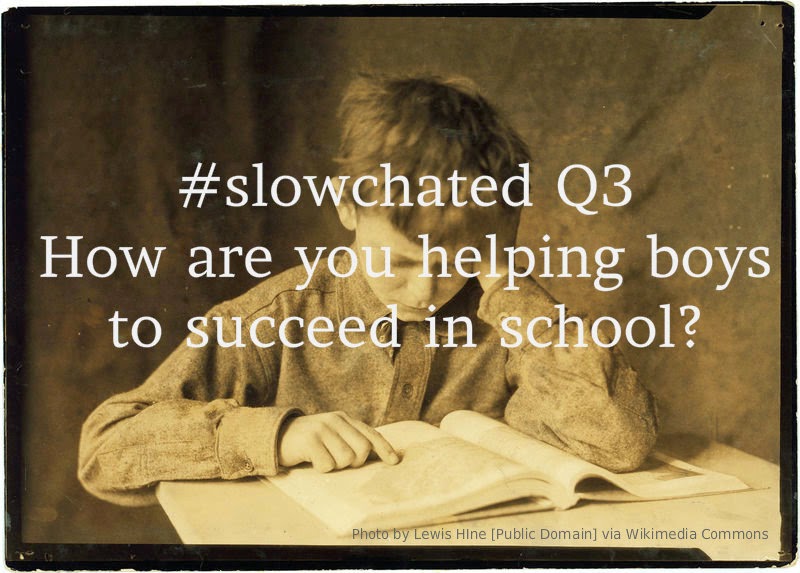
Sunday Summary: Boys & Men in Education #slowchated

After a week of discussing boys and men in education, I have even more questions than I did when I started. The biggest of those questions is how I should respond to the statistics that show boys struggling in schools. It's important to not generalize from the statistics: to continue to be responsive to the students in front of me, not the "average student" presented by the numbers. Still, the statistics concern me. How can we make school better for boys and boys better for school? Here is a selection of tweets from the week to assist you in finding your answer to that question.

I started the week with a cold opening. I hoped this question would elicit some emotion and strong opinion.
The answers ranged from uncertainty over whether this claim was true to collections of links about boys performance in school. Most responses, however, shared observations that may point to the problem.


And my first question also brought back the first reminder that we must be careful with these statistics to avoid stereotyping our students.

When I reflected on the statistics shared in my opening statement and from various tweets on Monday, I realized that I had seen many of the behavior statistics play out in my classroom (more frequent suspensions and discipline infractions related to bullying), than I had academic differences between boys and girls. That led to this question:


All of those tweets began to point at the problem, but the next ones really summed it up for me.


I've seen just as much inappropriate behavior from girls as boys, but boys are more likely to break a big school rule that results in harsh consequences like suspension. For example, bullying seems to happen equally with boys and girls, but boys' bullying is more likely to get physical and our school rules are clear that physical aggression results in suspension. Although the humiliation that can come with name-calling and rumors is just as damaging, if not more so, it is more difficult to determine when those behaviors warrant severe consequences.

After spending two days discussing the problem, it was time to look for solutions.
 Interestingly, no one mentioned something specific they were doing for boys. All of these strategies would benefit all students. The key seems to be breaking away from the traditional teacher lectures/student listens model.


Our fourth question went back to the big picture.
 Again, the suggestions were not specific to boys. When schools better meet the needs of all learners, boys' performance and school experience will improve, too.


I ended the week with a question I think about frequently as a male elementary school teacher. I've never worked (or attended) an elementary school with more than three male teachers. I've always felt that some boys get the idea that school and education is a female pursuit when they don't see men teaching classes. Being the Friday question, there weren't too many responses, but I think the one below says it all.
Male role models are important, whether or not they're found in schools. Still, this is an idea I would like to explore more, so I might dedicate an entire chat to this topic in the future.

Thanks to everyone who participated this week. I enjoyed seeing the thought put into the answers for this topic. I look forward to more discussions of big ideas with #slowchated

Tuesday, April 7, 2015

Boys & Men in Education #slowchated April 6 - 11

Boys are 22% more likely to repeat a grade than girls.
For every 100 girls diagnosed with a learning disability, 276 boys are diagnosed.
For over 50 years, girls have outperformed boys on standardized tests measuring reading ability.

"The Dunce" by Harold Copping [Public domain], via Wikimedia Commons
At first I wondered if all of these statistics were telling the truth. As a fifth grade teacher, I never noticed a gender gap in my classroom. I've had high performing boys and girls. I've also had just as many girls as boys requiring additional academic support through remediation and special education programs. Then I thought about it some more. In 12 years of teaching, I can only think of two girls who had an out of school suspension, but every year at least two boys from my classroom were suspended at some point during the school year. Nearly every time a student surprised me with uncharacteristically poor performance on a standardized test it was a boy. The students I've hounded most about homework, my least motivated readers, my students who required in-class aides: all boys. Something is going on here. And it isn't just a problem in the United States. Finland, who is often held up as a model of a successful school system, has twice the gender gap of the United States on the reading portion of the National Assessment for Education Progress.

Photo by deradrian via Flickr
What is causing these problems? Is it the way our schools are run? A Time Magazine article suggested that teachers discriminate against boys. Do we? Or is it boys themselves? Does the development of the male brain differ so much from the female brain to account for these statistics? How can we, as educators, address these issues?

All of these thoughts about boys in school led me to think about the men in my school. I've taught at two different elementary schools and had the distinction of being the only male classroom teacher in the building. Now that I'm the advanced learning specialist, there aren't any male classroom teachers in my building. How does the lack of male teachers in elementary schools affect boys? Current statistics show that men make up only 19% of the entire elementary and middle school teaching force. Could that be part of the problem of boys' underachievement? How can we encourage more men into our profession?

This isn't exactly an opening statement for the chat since we've already been discussing this topic for two days. Every Tweet and every link is giving me more to think about. I jotted down potential questions for the week when I signed up to moderate, but all of the great information we're discussing leads me down different paths. So I won't be posting questions in advance.

Please keep sharing, and remember that the beauty of a slow chat like this is having the freedom to take time. Explore the posted links, find additional statistics and articles to share, and engage with the rest of the #slowchated community. I look forward to seeing what you contribute.

Monday (4/6/2015)
 Tuesday (4/7/2015)
 Wednesday (4/8/2015)
Thursday (4/9/2015)
Friday (4/10/2015)