Saturday, September 5, 2015

Getting ready

Another school year starts on Tuesday. Am I ready? I sure hope so. No matter what next week brings, I had a terrific week of getting ready for the new school year.

On Monday, my principal gathered our entire school staff for team building and goal setting at the North Idaho College Challenge Course. We've always had a tight staff, but it was amazing to see the trust exhibited on that ropes course. About half of us were willing to go up and try the high wires, rickety bridges, and swinging balance beams, but everyone took part hoisting ropes and working together on the ground-based challenges. It was the best start to teacher meetings I've ever experienced.

Tom Schimmer came to speak to all of our district's teachers about grading on Tuesday. He presented the idea of a standards-based mindset for grading. I really got a lot from his presentation, but the best were his explanations of summative vs. formative assessment that helped me understand the difference better than ever. We also received copies of How to Grade for Learning by Ken B. O'Conner for a district-wide book study. I'm excited to delve into this topic.


Speaking of book studies, my school staff read Dave Burgess's Teach Like a Pirate this summer. I read it the year before, but I was happy to share the experience with my staff. We had a pirate party to celebrate and discuss some of the ideas that came from reading it. Many of the teachers commented that the high school orientation of the book was difficult, but everyone came away with ideas for the coming school year. For me, the best part of our discussions was hearing about the plans to bring more joy into the classroom. The emphasis on testing and rigor has taken a toll on our kids and I'm glad to see our school focus on incorporating more fun and excitement into the good work we're already doing. I put up a Teach Like a Pirate bulletin board in our staff room with space for teachers to add notes about the ways the book affects their classrooms. I look forward to seeing what shows up there.

In addition to getting ready for the new school year as a teacher, I am the parent of a kindergartener this year. Thursday was kindergarten orientation for parents and our school's open house. Orientation was a remarkable event. My school's kindergarten team, Title I teacher, and district math coaches gave parents games and strategies to help their little guys succeed. We left the event with great information on assisting our son with handwriting, reading, and number sense. The evening's open house was a blast, too. It totally changed my perspective to experience this event as a parent. My son is lucky to have some friends from preschool in his class, because I think that helped put him at ease. He also got to meet his teacher, find his locker, and play on the playground. He seems really excited to start school next week: I'm the one who's nervous about it.

Finally, I was able to end the week with one of my favorite things: seeing and hearing live music. Sarah and I went to see Junior Brown in Spokane at Pig Out in the Park. I've loved Junior Brown's music since I was in high school. I saw him perform last time he visited the area nearly 20 years ago, when the world looked like this music video.

If it's possible, he was even better at playing the guit-steel this time around. The sounds he creates with his instrument are absolutely jaw-dropping. When we discussed it on the way home, we figured that he's had 20 more years of practice. I want to continue improving my practice as a teacher the way he has improved as a musician - maintaining my enthusiasm, experimenting with new techniques, and refining my craft. Here's to another year of practice!


Here's some more recent concert footage if you want to see what I mean about what happens with 20 years more practice!

Thursday, August 27, 2015

Inspiration from #ThinkBigFest2015

Last spring I heard about a technology conference coming to Coeur d'Alene. There were promises of robots, self-driving cars, and the people who bring those technologies to life. It wasn't an education conference, yet I was excited. The Think Big Festival was outside my personal budget for these type of things, but the organizers were kind enough to offer some free registrations to our school district (which I missed out on) and discounted registration for other interested teachers (Thank you so much for that, Nick Smoot).

It was an amazing event, and it gave me lots to think about. I'm still figuring out how to bring things I learned about there into my classroom. Hopefully you'll read about those later this school year on my blog. For now, I'll share some highlights.


I took a ride in a Tesla S. I signed up too late to get an actual test-drive, but someone who did was kind enough to let me sit in the back seat. That is one incredible vehicle. I had never ridden in anything with such high performance and luxurious finish, but the engineering and ideas were even more impressive. The Tesla representative that rode along with us explained how nearly all of the components are built from scratch and Tesla's commitment to being completely U.S. made. He also had a great story about the impact of education: one of his high school science teachers took a group to visit Tesla headquarters when he was 16 years old. He was so impressed that he bought stock in the company. By the time he finished college, he had received an impressive return on his investment and was able to get a job managing the roll-out of Tesla's infrastructure in the Northwest.


On the test drive, I got to ride next to 10 year old inventor, Alexander Knoll. He is this year's Invent Idaho and I Cubed Challenge winner with his Ability App. We exchanged business cards and I got him to agree to videoconferencing with some of my students later this year to get them pumped up about inventing and participating in our school's Invent Idaho competition.

I captured the most touching moment of the festival above. Guy Fraker, one of the festival's panelists, announced that his company would partner with Alex to make sure his invention was fully funded and on the market within a year.

Aquaai unveiled their robotic fish at the conference. It is able to swim with just one motor and the company would one day like it to swim waterways and broadcast images back to shore. It sounds like social media for the aquasphere, and it's definitely something I would like my kids to experience.

Another highlight from the day of speakers and panels was hearing Burt Rutan, designer of Spaceship One. He talked a lot about going for it and doing the impossible. He said, "You  have to have confidence in nonsense if you are going to have a research breakthrough." I think that is a good reminder to honor our students' ideas, no matter how crazy they get. You never know where they might lead.

Guy Fraker was also a part of the transportation panel and he shared the story of his son with autism first seeing a video of Google's self-driving car. For the first time, his son could imagine owning a car and having the independence that goes with it.


The final day of the festival was a playground of cool technology. My son and I got to try out virtual reality with Google Cardboard and Oculus Rift. I absolutely want to get Cardboard for my classroom so students can see places like the Smithsonian Air and Space Museum Udvar-Hazy Center from inside the photosphere. There were lots of robots including the Aquaai robot fish, homemade remote control submarines for collecting water samples, and the work of a local high school robotics team. I also got my second high-tech vehicle ride of the week when I got to see how the sensors for autonomous vehicles work in the Polysync car.

I'm so glad I attended this year's Think Big Festival. As promised, it gave me a lot to think about. I was amazed by how many innovative things are being developed locally. I would love to connect my students with those companies and individuals to help them understand that even though we aren't in the big city, there are opportunities here, and a great idea can create opportunity anywhere. Maybe something I learned about will inspire a three-act task or a project this year: I'll just have to keep you updated as I experiment and refine...


You can see some more perspectives of the event in the Storified version of the conference's Twitter activitiy.


Sunday, May 31, 2015

My students actually printed in 3D


Students watching Pinkie Pie at work
Since I first saw a 3D printer demonstration, I've been thinking about how to put that technology to use in my classroom. Luckily I was able to work out a partnership with my local library to make it happen.

Tinkercad was an ideal design platform
We kicked off our project with a visit from Nick Madsen, the teen services librarian, and his 3D printer, Pinkie Pie. He printed a mustache for our class while explaining the basic idea behind 3D printing: "It's like a computer-controlled hot glue gun that shoots out plastic instead of glue." My students were amazed, as was my principal, custodian, and many other staff members who poked their heads in the room to see 3D printing in person.

My 4th grade math class used Tinkercad to create their own 3D printed nametags. I was really impressed with how easily they could create with Tinkercad: after spending two class periods on tutorials, students were able to make their own designs in under an hour. Plus, Tinkercad worked flawlessly on Chromebooks. I gave my students some parameters on size, but the designs were entirely up to them. I also used the design process to sneak in some instruction on perimeter and area.

I uploaded using the library's Skyforge site
The finished nametags were great! Nearly all my students were happy with the way their designs turned out. I wish we had more time to use the finished products to do some measuring and scaling work, but testing schedules and end of the year field trips made that impossible.

I definitely want to do more with 3D printing next year and integrate it into more lessons. I'll start by seeking some grant money to fund a printer at our school. Our art teacher has a lot of ideas for it, too, so we'll probably collaborate on a way to bring 3D printing to our school.

The finished product
Do you have any recommendations when it comes to 3D printing equipment? Or maybe you have an idea to share on using 3D printing with elementary students. Please share your ideas in the comments below or contact me on Twitter. And I'll keep you updated as I continue to experiment and refine...

Sunday, May 3, 2015

The swinging new sounds of professional development

Since becoming my official Building Technology Leader, I've been working to provide meaningful professional development to my colleagues. I often share a new tool or idea with my staff at our collaboration sessions or staff meetings. I have made it a priority to give teachers time to discuss, experiment, and play with new technology in my sessions, but everyone seems a little reserved and hesitant and I can tell that many are much more concerned with the impending morning bell and preparing for the day to come. I knew I could make professional development more engaging and memorable. Press 'play' below, read on, and see what I mean.


Welcome to Monday Morning Appy Hour!

Care for a drink? It's okay, these mimosas are made with 7-Up, not champagne. Fire up that iPad and learn about a few new apps.

Stemware & iPads: what a combination!
The content of Monday Morning Appy Hour wasn't radically different from my other PD sessions. I shared SeeSaw, ChatterPix, Shadow Puppet EDU, and Telestory, discussed the importance of moving students from consumers to creators, and gave everyone some time to try the apps and generate ideas on how they could be used in the classroom. The attitude and level of participation, though, was a huge improvement from my past morning trainings. Everyone was having fun, and they were really discussing how they could use these tools in their classrooms.

So, is providing refreshments the key to engaging PD? I don't think so. I transformed my classroom and broke everyone there out of the expected environment. I've done it before for my students by disguising myself as a signer of the Constitution and being my own substitute teacher for the day or starting class with kindergarten-style circle time for fifth graders, but I'd never transformed a presentation intended for other teachers.

PD featuring the smooth instructional stylings of
Jim Windisch
In Teach Like a Pirate, author Dave Burgess devotes an entire chapter to transformation. In the chapter, he asks a powerful question: "If your students didn't have to be there, would you be teaching in an empty room?" Teachers are busy; they have a lot to do to be ready for the day each morning. As much as they want to learn new technology, I know my PD sessions wouldn't be everyone's first choice for that precious before-school time. This session was optional, but most of my school's staff was there. In fact, after the first couple teachers came in, received their drink and heard the lounge music, they went and grabbed others because "Mrs. X just needs to see this!" It went from a training to an event.

Making it fun loosened everyone up. They were excited to participate. The room was full of terrific conversations about giving students opportunities to create. I jumped in to support and tell some lousy jokes, but I refrained from actually doing any lounge singing. 

It was also a memorable experience. I feel like breaking away from the ordinary got the morning's content stuck in the participants' heads. Instead of having teachers ask me to remind them the names of the apps, they're coming to me to share how they've incorporated them into lessons and looking for support to take it a step further.

I'm sure this is only my first foray into transforming professional development. I'm already thinking of themes for future sessions. And I'll keep you updated at I continue to experiment and refine. 

Thank you, thank you, and especially, thank you. Remember to tip generously. I'll be here all week!

Sunday, April 12, 2015

Sunday Summary: Boys & Men in Education #slowchated

After a week of discussing boys and men in education, I have even more questions than I did when I started. The biggest of those questions is how I should respond to the statistics that show boys struggling in schools. It's important to not generalize from the statistics: to continue to be responsive to the students in front of me, not the "average student" presented by the numbers. Still, the statistics concern me. How can we make school better for boys and boys better for school? Here is a selection of tweets from the week to assist you in finding your answer to that question.

I started the week with a cold opening. I hoped this question would elicit some emotion and strong opinion.
The answers ranged from uncertainty over whether this claim was true to collections of links about boys performance in school. Most responses, however, shared observations that may point to the problem.


And my first question also brought back the first reminder that we must be careful with these statistics to avoid stereotyping our students.

When I reflected on the statistics shared in my opening statement and from various tweets on Monday, I realized that I had seen many of the behavior statistics play out in my classroom (more frequent suspensions and discipline infractions related to bullying), than I had academic differences between boys and girls. That led to this question:


All of those tweets began to point at the problem, but the next ones really summed it up for me.


I've seen just as much inappropriate behavior from girls as boys, but boys are more likely to break a big school rule that results in harsh consequences like suspension. For example, bullying seems to happen equally with boys and girls, but boys' bullying is more likely to get physical and our school rules are clear that physical aggression results in suspension. Although the humiliation that can come with name-calling and rumors is just as damaging, if not more so, it is more difficult to determine when those behaviors warrant severe consequences.

After spending two days discussing the problem, it was time to look for solutions.
 Interestingly, no one mentioned something specific they were doing for boys. All of these strategies would benefit all students. The key seems to be breaking away from the traditional teacher lectures/student listens model.


Our fourth question went back to the big picture.
 Again, the suggestions were not specific to boys. When schools better meet the needs of all learners, boys' performance and school experience will improve, too.


I ended the week with a question I think about frequently as a male elementary school teacher. I've never worked (or attended) an elementary school with more than three male teachers. I've always felt that some boys get the idea that school and education is a female pursuit when they don't see men teaching classes. Being the Friday question, there weren't too many responses, but I think the one below says it all.
Male role models are important, whether or not they're found in schools. Still, this is an idea I would like to explore more, so I might dedicate an entire chat to this topic in the future.

Thanks to everyone who participated this week. I enjoyed seeing the thought put into the answers for this topic. I look forward to more discussions of big ideas with #slowchated

Tuesday, April 7, 2015

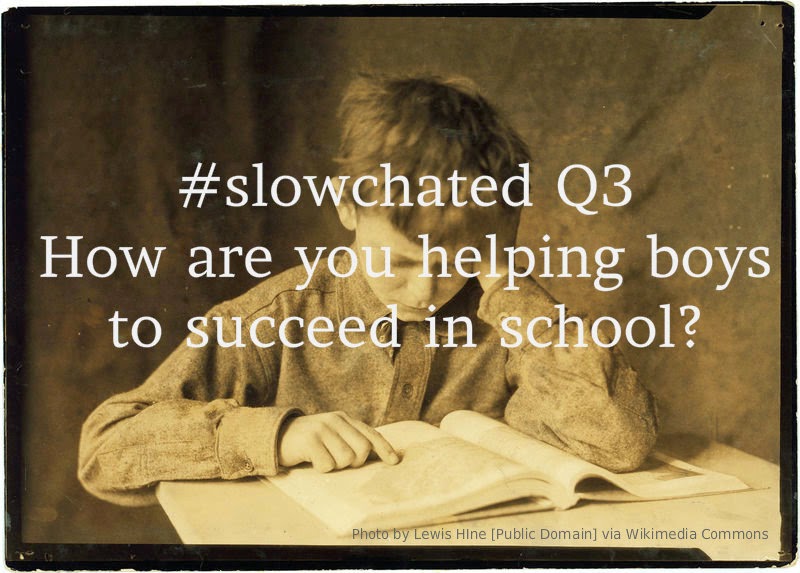
Boys & Men in Education #slowchated April 6 - 11

Boys are 22% more likely to repeat a grade than girls.
For every 100 girls diagnosed with a learning disability, 276 boys are diagnosed.
For over 50 years, girls have outperformed boys on standardized tests measuring reading ability.

"The Dunce" by Harold Copping [Public domain], via Wikimedia Commons
At first I wondered if all of these statistics were telling the truth. As a fifth grade teacher, I never noticed a gender gap in my classroom. I've had high performing boys and girls. I've also had just as many girls as boys requiring additional academic support through remediation and special education programs. Then I thought about it some more. In 12 years of teaching, I can only think of two girls who had an out of school suspension, but every year at least two boys from my classroom were suspended at some point during the school year. Nearly every time a student surprised me with uncharacteristically poor performance on a standardized test it was a boy. The students I've hounded most about homework, my least motivated readers, my students who required in-class aides: all boys. Something is going on here. And it isn't just a problem in the United States. Finland, who is often held up as a model of a successful school system, has twice the gender gap of the United States on the reading portion of the National Assessment for Education Progress.

Photo by deradrian via Flickr
What is causing these problems? Is it the way our schools are run? A Time Magazine article suggested that teachers discriminate against boys. Do we? Or is it boys themselves? Does the development of the male brain differ so much from the female brain to account for these statistics? How can we, as educators, address these issues?

All of these thoughts about boys in school led me to think about the men in my school. I've taught at two different elementary schools and had the distinction of being the only male classroom teacher in the building. Now that I'm the advanced learning specialist, there aren't any male classroom teachers in my building. How does the lack of male teachers in elementary schools affect boys? Current statistics show that men make up only 19% of the entire elementary and middle school teaching force. Could that be part of the problem of boys' underachievement? How can we encourage more men into our profession?

This isn't exactly an opening statement for the chat since we've already been discussing this topic for two days. Every Tweet and every link is giving me more to think about. I jotted down potential questions for the week when I signed up to moderate, but all of the great information we're discussing leads me down different paths. So I won't be posting questions in advance.

Please keep sharing, and remember that the beauty of a slow chat like this is having the freedom to take time. Explore the posted links, find additional statistics and articles to share, and engage with the rest of the #slowchated community. I look forward to seeing what you contribute.

Monday (4/6/2015)
 Tuesday (4/7/2015)
 Wednesday (4/8/2015)
Thursday (4/9/2015)
Friday (4/10/2015)


Saturday, April 4, 2015

Inspiration from #NCCE2015

Image from blog.ncce.org
I've been home from the NCCE-Northwest Council for Computer Education conference for two weeks, and my head is still spinning with all of the educational awesomeness I encountered there. It was my first time at a big education conference, and I did my best to take it all in. I attended 14 sessions and workshops and kept up with countless more via Twitter. I walked every aisle of the exhibit hall, and spent all of my free time connecting with inspiring educators from around the country.

New Tech Ideas
Collaboration is the big idea in education right now. I learned strategies for managing collaborative work in Google Drive including having students experiment with collaborative documents by starting with a spreadsheet with their own assigned rows (thanks Nikki Robertson). Cheryl Steighner hosted a terrific session about Google in elementary schools. One of her ideas is to have a collaborative story that students can add to over time. She has one story that students have continued even two years after leaving her classroom! Throughout my time in Portland, I heard about countless apps, websites, and tools that I will be exploring for months to come.

Connections
As great as the official sessions and workshops were, the best part of attending NCCE was connecting with other educators. There were quite a few sessions about how important it is to build a personal learning network (PLN) through Twitter or another social learning platform. I am a full-fledged Twitter evangelist, and my time at NCCE proved why. Everywhere I went, I ran into people I already knew. We were able to jump in and discuss because we already knew each other's backgrounds. I added many more educators to my PLN so I could continue to learn from them after NCCE.

Excuse the random
photo, but the mens'
rooms in the Portland
Convention Center have
amazing artwork!
One highlight of connecting at NCCE was Wednesday's #IDedchat. We met at a swanky, 30th story bar in downtown Portland to discuss professional development. It was a little strange staring at our phones to chat online when we were in such a beautiful place with great company, but being together created a more festive atmosphere for the chat. Plus, most of us arrived early to share dinner and chat.

I also got to have a wonderful lunch with Cheryl Steighner to discuss tubas and elementary education, and I spent a night on the town with some of my colleagues from Coeur d'Alene (Kelli Ogle and Kiersten Kerr are the only ones on Twitter) and Nikki Robertson from Alabama. I also got to chat with one of the most inspiring bloggers I know, Steve Wyborney, in the exhibit hall. Those informal learning moments were the best of the conference!

Now it's time to put what I've learned in to action. On Monday, I'm hosting a Monday Morning Appy Hour at my school to share some of the iPad apps I learned, and I'm working many of the other ideas I learned into upcoming lessons. It also sparked a desire to attend (and possibly present at) other big conferences. We'll just have to see where that leads, and I'll keep you updated as I continue to experiment and refine...